Battery Capacity: How to Calculate It and Choose the Right Battery


 5 min read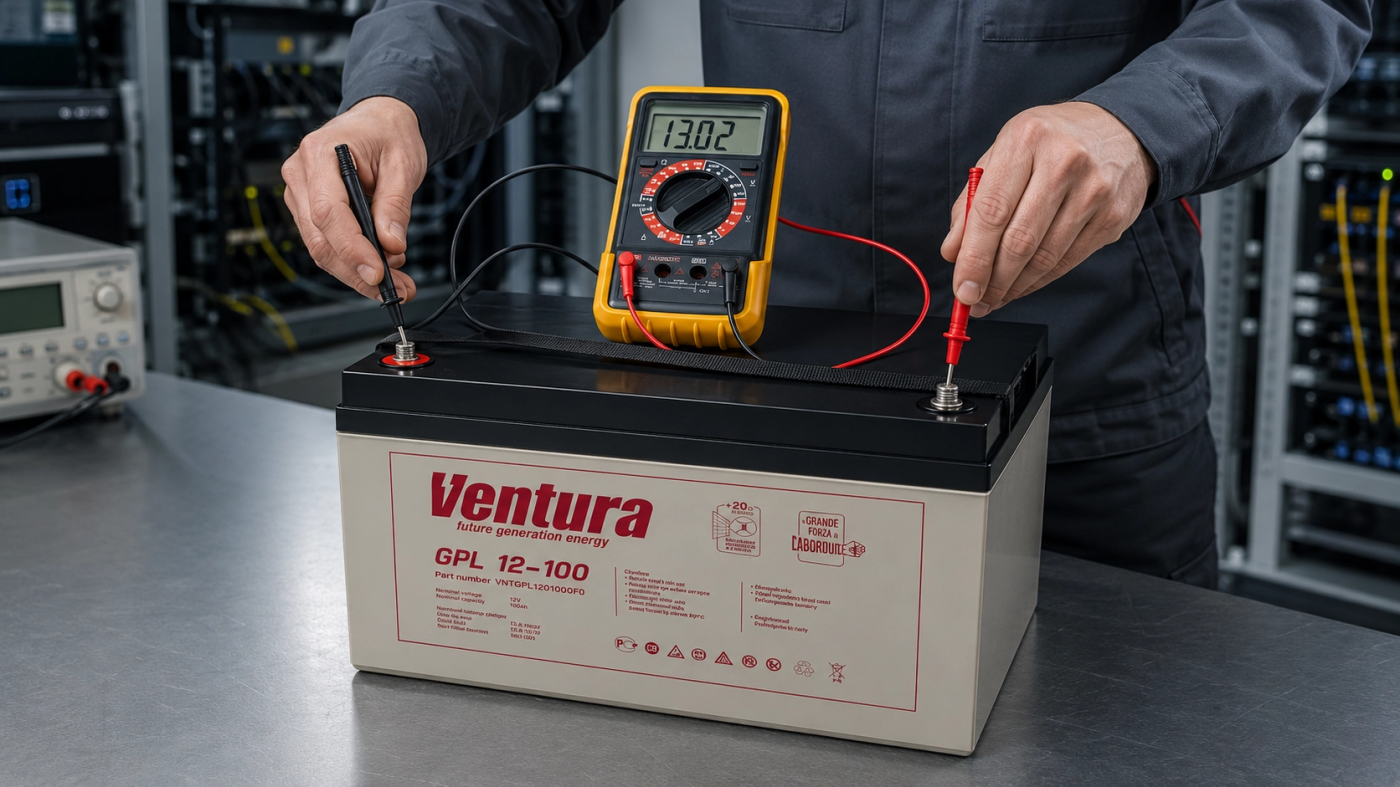
Battery capacity is a parameter that directly determines how long the equipment will operate on backup power. An error in calculation results in either paying for unnecessary capacity or insufficient backup duration at a critical moment. For engineers and specialists in the operation of UPSs, data centers and telecom facilities, it is important to understand not only the number in ampere hours on the label, but also the conditions under which the available capacity differs from the rated capacity.
What is battery capacity in simple words
Ampere-hour capacity is the amount of electrical charge that a fully charged battery is capable of delivering at a given current, temperature, and final discharge voltage. Energy capacity is expressed separately in watt-hours.
Capacity must be distinguished from state of charge (SoC): it indicates what proportion of available charge remains in the battery at a given moment. The charge level changes during operation, and the nominal capacity remains the nameplate characteristic of the battery. However, the actual available capacity depends on the discharge mode, temperature and condition of the battery.
How is battery capacity measured?
Ampere hours (Ah)
Ampere hour (Ah) is a unit of electrical charge. At constant current, the delivered capacity is calculated by the formula C = I × t, where C is the capacity in Ah, I is the discharge current in amperes, t is the discharge time in hours. For example, a rating of 60 Ah at C20 means that the capacity is determined at a 20-hour discharge current of about 3 A to the specified final voltage. This does not mean that the battery will be able to supply 60A for an hour.
As the current increases, the available capacity of a lead-acid battery decreases. Therefore, when comparing batteries, it is necessary to take into account the discharge mode specified by the manufacturer, for example C10 or C20, temperature and final voltage.
Watt hours (Wh) and energy capacity
The nominal energy reserve can be tentatively estimated using the formula: energy (Wh) ≈ capacity (Ah) × rated voltage (V). For example, the rated energy storage of a 48V 100Ah battery assembly is approximately 4800Wh. Provided that 80% of this reserve is used and without taking into account converter losses, the estimated operating time of a 250 W load will be about 15.4 hours. The actual time must be clarified using the battery discharge tables, taking into account the final voltage and equipment efficiency.
What types of battery capacity are important to distinguish?
When choosing and evaluating a battery, it is important to distinguish between several types of capacity:
-
Rated capacity is the amount of electrical charge declared by the manufacturer that a fully charged battery is capable of delivering at a given current, temperature and final voltage. The designation C20 is used if the capacity is determined at a 20-hour discharge.
-
Actual capacity is the amount of charge actually obtained during a control discharge under specified conditions.
-
Residual capacity is the amount of charge that the battery is still capable of delivering from its current state to the set final voltage.
-
Reserve Capacity (RC) - Used primarily for starter batteries, a measure of the time in minutes that a fully charged 12-volt battery is capable of delivering 25 A of current before the voltage drops to 10.5 V under specified test conditions.
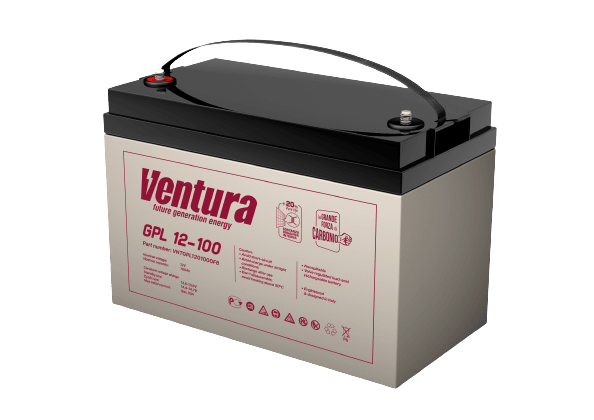
Sealed lead-acid batteries of the Ventura GPL series, made using AGM technology, are suitable for stationary systems and UPSs. Published discharge characteristics allow you to select a battery taking into account the required runtime, load power and final discharge voltage.
What determines the actual battery capacity and what reduces it
-
Operating temperature. As the temperature drops, the chemical reactions inside the battery slow down, so the available capacity decreases. Elevated temperatures may temporarily increase capacity, but at the same time accelerate grid corrosion and battery aging, shortening battery life. The specifications for lead-acid batteries are usually given for temperatures around 20–25 °C, and corrections for other conditions are determined from the manufacturer.
-
Current and nature of the discharge. The higher the discharge current relative to the rated mode, the less capacity the lead-acid battery is capable of delivering. This nonlinear relationship is approximately described by Peukert's law. The value of the Peukert index depends on the design, condition and characteristics of a particular battery, therefore the manufacturer’s data is used for calculations.
-
Degree of wear and operating conditions. The available battery capacity gradually decreases as the battery ages and charges and discharge cycles accumulate. The rate of decline depends on temperature, depth and current of discharge, charging mode and battery design. The deeper the regular discharge, the shorter the cycle life, therefore the permissible discharge depth is chosen according to the recommendations of the manufacturer of a particular series.
How to check the capacity of a lead-acid battery without errors

The most accurate way to determine capacity is a control discharge. The battery is fully charged according to the manufacturer's instructions, after which it is discharged with direct current to the specified final voltage. The discharge current, temperature and cut-off voltage are selected in accordance with the rated test conditions with which the result will be compared. At constant current, the delivered capacity is calculated using the formula C = I × t, and after the test the battery must be fully charged again.
It is important to understand the limitations of alternative methods. Measuring voltage with a multimeter does not directly determine capacity and only gives a rough estimate of the battery's charge level at rest. Rapid testers that evaluate internal resistance or conductivity help identify deteriorating battery condition, but do not replace the test discharge in measuring actual capacity. The electrolyte density test is only applicable to serviceable wet batteries and is not suitable for sealed AGM or GEL batteries.
Conclusion: how to choose a battery with a suitable capacity
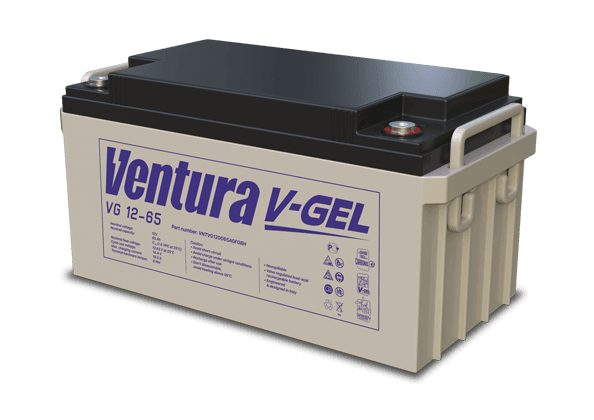
The selection of capacity begins with the load profile: it is important to accurately determine the total power of the connected equipment, the required runtime and the operating temperature range. Only after this do they move on to choosing a technology and a specific series. For uninterruptible power supplies of small and medium power, you can consider Ventura GP batteries, and for systems where high cycle life and resistance to deep discharges are important, Ventura V-Gel.
When selecting a battery, the decrease in capacity with aging, the minimum operating temperature, equipment efficiency, possible load growth and design reserve are taken into account separately. The amount of the required reserve depends on the operating conditions and requirements for system reliability, therefore it is determined by calculation, and not by a single percentage for every site.
Frequently asked questions
What does battery capacity mean in simple words?
This is the amount of electrical charge that the battery is capable of delivering to the connected equipment in one discharge cycle - from full charge to the set cut-off voltage.
What is the difference between ampere hours and watt hours?
Amp-hours indicate the amount of electrical charge delivered at a given discharge mode and final voltage. Watt-hours reflect the energy supply taking into account battery voltage: Wh ≈ Ah × V. This indicator is convenient for preliminary comparisons of systems with different nominal voltages.
How does the nominal capacity differ from the actual capacity?
Nominal capacity is the value declared by the manufacturer, determined at a given current, temperature and final discharge voltage. Actual capacity is the amount of charge obtained during a test discharge of a specific battery under specified conditions.
Why may the actual battery capacity be lower than the nominal capacity?
Actual capacity may be lower than rated capacity due to low temperature, high discharge current, natural aging and the effects of deep cycling. Elevated temperatures may temporarily increase the delivered capacity, but it accelerates battery degradation and leads to its decline in the future. The more real-life conditions differ from those of the nameplate tests, the more noticeable the discrepancy between the nominal and actual capacity may be.
Is it possible to determine the battery capacity with a multimeter?
The multimeter does not measure capacity directly. To determine it, a fully charged battery is discharged with direct current to the final voltage set by the manufacturer and the discharge time is recorded. Capacity is calculated using the formula C = I × t. Rapid testers allow you to quickly assess the condition of the battery, but the most reliable value of the actual capacity is obtained during a test discharge.
How to understand what battery capacity is needed for equipment?
For a preliminary assessment, the load power is multiplied by the required runtime, and the resulting value is divided by the voltage of the battery assembly, the efficiency of the converter and the permissible discharge fraction. For example, with a load of 500 W, backup duration 2 hours, voltage 48 V, efficiency 0.9 and permissible discharge fraction 0.8, about 29 Ah will be required in advance. The final rating is selected based on the discharge characteristics of a particular battery, taking into account the final voltage, temperature, aging and design reserve.
GP (General Purpose)
Learn more
GP

GPL (General Purpose Longlife)
Learn more
GPL
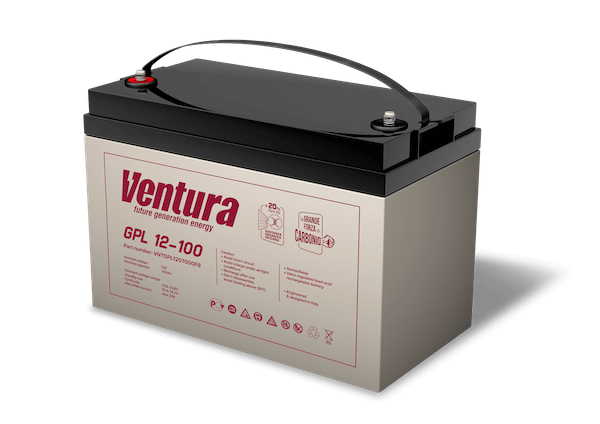
VG (Gel Viscoso)
Learn more
VG