What AGM Means and How AGM Batteries Work: Inside the Manufacturing Process


 4 min read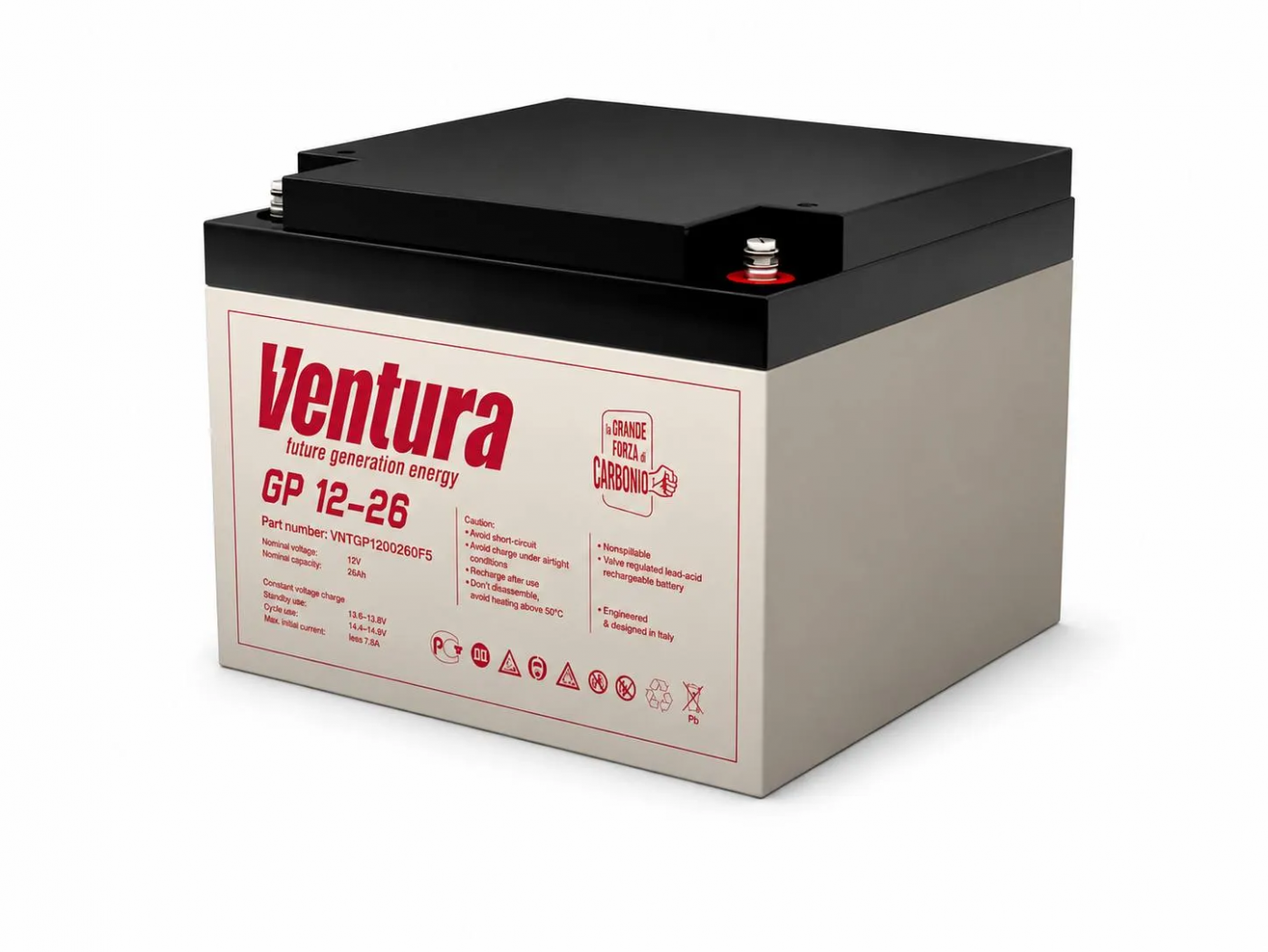
AGM is one of the most popular technologies in industrial, infrastructure and household power supply. Batteries of this type are used in backup and autonomous power systems for data centers, telecommunications centers, medical institutions, banks, industrial enterprises, security systems and other equipment. Engineers, designers and operators choose them for their predictable service life, maintenance-free operation and high current output. The secret to the reliability of such batteries lies in the nuances of production: precise machine assembly, tight compression of the plates with a fiberglass mat and strict dosing of the electrolyte. In this material we analyze the structure of AGM batteries, the principle of operation, operating and charging rules.
What is an AGM battery and what does AGM technology mean
AGM stands for Absorbent Glass Mat - an absorbent fiberglass separator. The design principle behind the abbreviation is that the electrolyte in such a battery is absorbed by fiberglass mats located between the plates. This is what distinguishes AGM from classic lead-acid batteries with free electrolyte.
AGM technology was developed in the 1970s and was initially used in aviation and military applications, where the requirements for reliability, vibration resistance and sealing are particularly high. Today, AGM batteries are manufactured according to IEC 60896-21/22 standards for stationary VRLA batteries, and also comply with the requirements of GOST R 53165 and the technical regulations of the EAEU. This means that products supplied to the Russian market undergo mandatory certification and confirm compliance with established safety standards and electrical parameters.
How an AGM battery works
The design of the AGM battery is based on the principle of VRLA (Valve Regulated Lead-Acid) - a valve-regulated lead-acid power source. Main structural elements:
-
Positive and negative plates made of lead and its alloys, including those with the addition of calcium to reduce self-discharge and increase battery life.
-
The fiberglass separator is an AGM mat that holds the electrolyte (an aqueous solution of sulfuric acid) in an absorbed state. The main difference between AGM and batteries with free electrolyte is not the presence of the separator itself, but the way the electrolyte is retained inside the fiberglass mat.
-
The overpressure valve is activated when the pressure inside the housing increases, such as during overcharging, and releases excess gas. The design eliminates the need to add distilled water, but the battery remains valve-regulated rather than completely sealed.
-
Housing made of impact-resistant ABS plastic with integrated terminals and terminal system (F-type, M5/M6/M8 screw terminals and others depending on the series).
The electrochemical process in the AGM battery ensures oxygen recombination at the negative electrode with up to 99% efficiency. This means minimal gas emissions during normal operation and allows batteries to be placed in enclosed spaces - server rooms, control rooms, medical rooms - subject to the requirements for space, ventilation and charging equipment. For the designer, this significantly expands the battery bank placement options.
Advantages of AGM batteries
Maintenance-free. The valve-regulated design eliminates the need to monitor the electrolyte level and density and add water. This reduces operating costs and allows the battery to be integrated into automated systems without the regular participation of technical personnel.
High current output. AGM batteries are capable of providing discharge currents of 5–10C and higher, which is critical for powering systems with pulsed loads: UPS, telecommunication equipment, starting systems of industrial engines.
Wide temperature range. Industrial batteries retain functionality at temperatures from −20°C to +50°C. When operating at low temperatures, AGM batteries retain the ability to deliver short-term high currents due to their low internal resistance.
Low self-discharge. The use of plates with added calcium reduces the self-discharge rate to 1-3% per month at +20°C. This is especially important for seasonal backups or long-term storage of spare batteries.
Vibration and shock resistance. Fixed with a fiberglass mat, the electrolyte does not move within the housing, which provides resistance to mechanical stress - a critical property for transport and mobile applications.
Installation in different positions. The absence of free electrolyte allows AGM batteries to be installed horizontally, vertically or on their sides (except for the terminal-down position) - depending on the configuration of the UPS rack or battery cabinet.
Possible restrictions
AGM batteries are optimal for float charge operation. When designing systems with intense cyclic loads and requiring more than 300–500 full deep discharge cycles, it is advisable to consider traction series or GEL/V-Gel technologies with a higher cycle life.
How do AGM batteries differ from conventional lead-acid and gel batteries
Understanding the differences between battery types helps you make informed design decisions. Below is a comparison of key technologies in the lead-acid battery class.
|
Parameter |
Regular WET/OPzS |
AGM (VRLA) |
GEL/V-Gel |
|
Electrolyte condition |
Liquid solution (free) |
Absorbed by fiberglass mat |
Thickened with silica gel |
|
Maintenance |
Requires topping up water |
Maintenance free |
Maintenance free |
|
Current output |
Medium |
High |
Medium/high |
|
Cycle life |
500–1500+ cycles |
200–500 cycles |
500–1000+ cycles |
|
Service life (float) |
10–20 years |
5–12 years |
10–15 years |
|
Working in low temperatures |
Satisfactory |
Good |
Excellent |
|
Installation position |
Strictly vertical |
Vertical, horizontal or on its side, except terminals down position |
Depending on the manufacturer's recommendations |
|
Typical Application |
Stationary installations |
UPS, data center, communications, transport |
UPS, energy storage systems, telecom |
The key difference between battery types is the method of fixing the electrolyte. In AGM it is absorbed by the fiberglass mat of the separator, in GEL/V-Gel it is thickened with silica gel. Each of the technologies is optimal for its tasks: AGM - for float applications with high current output requirements, GEL/V-Gel - where extended cycle life and operation in difficult climatic conditions are important.
Where are AGM batteries used
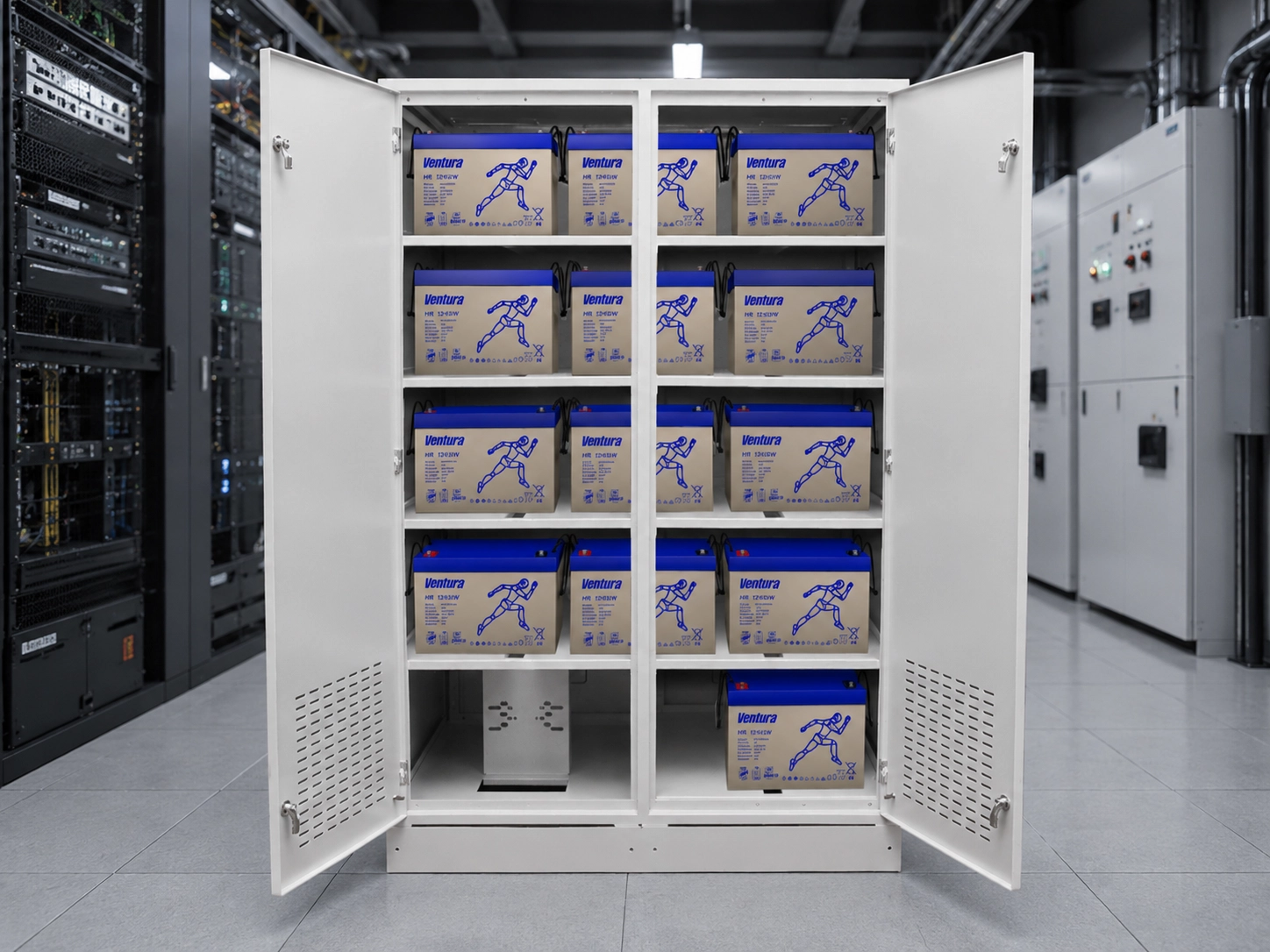
AGM batteries occupy a dominant position in industrial and commercial backup and autonomous power systems. Key Applications:
-
Uninterruptible power supplies (UPS). AGM is the most common type of battery for UPS with a capacity of 1 kVA to several MVA. The ability to maintain voltage within the operating range during discharge helps ensure the correct operation of power electronics.
-
Data centers. Batteries are installed in rack cabinets and battery cabinets. The absence of regular user maintenance, valve-regulated design and minimal off-gassing during normal operation makes it easy to integrate batteries into data center infrastructures with stringent environmental requirements, including off-gassing and fire safety.
-
Telecommunications and communications. Cellular nodes, 4G/5G base stations, backbone switches - equipment that needs backup power capable of supporting the load for 2–8 hours.
-
Medical institutions. Power supply for diagnostic and surgical equipment, life support systems places strict demands on battery reliability and minimal gas emissions. AGM batteries fully meet these criteria.
-
Banking and financial infrastructure. ATMs, trading terminals, and processing centers use AGM batteries as part of distributed UPS systems.
-
Security and fire systems. Access control, fire alarm and video surveillance systems require power supplies with low self-discharge and readiness to supply power when the main network is turned off.
-
Transport infrastructure and energy storage systems. AGM batteries are used in backup power supply of railway facilities, airports, as well as in standby and hybrid energy storage systems based on solar and wind power plants with a moderate number of cycles.
How to properly operate and charge an AGM battery
The correct operation of the AGM battery directly determines whether it will last its intended life. AGM technology places specific requirements on charging modes, temperature conditions and discharge depth - compliance with these parameters ensures stable operation of the battery throughout the entire declared service life. That is why the issues of charging and operating batteries are not considered separately, but in conjunction with the installation conditions and operating mode of the equipment.
How to properly charge an AGM battery
Charging of AGM batteries is carried out according to an algorithm with voltage and current control. In float mode, a constant voltage is maintained: for most 12-volt AGM batteries it is 13.5–13.8 V at +25°C. For a recovery charge (Boost), a voltage of 14.4–14.7 V is used, followed by a transition to float mode.
Temperature compensation is critical: when operating above or below +25°C, the charging voltage is adjusted according to the manufacturer's specifications – typically by −3...−5 mV/°C/cell. Proper consideration of the temperature coefficient directly affects the longevity of the battery and the retention of capacity throughout the entire design service life.
How to choose a charger for AGM batteries
To charge AGM batteries, you should use professional chargers that support IUI, IUoU algorithms or similar multi-stage modes. The device must support the AGM/VRLA profile and automatically switch between charge phases without operator intervention.
Before starting work, it is useful to check the condition of the battery using a multimeter: the voltage of a fully charged 12-volt AGM battery at rest is 12.7-12.8 V. Values below 12.0 V indicate the need for a recovery cycle. Do not use chargers designed for car batteries with open electrolyte: they do not provide the required voltage control accuracy.
What charging errors reduce battery life
Among the main factors that reduce the life of AGM batteries:
-
Systematic excess of the charge voltage leads to accelerated degradation of the plates and an increase in internal pressure in the cells.
-
Constant undercharging is especially critical during cyclic use and reduces the available battery capacity.
-
A prolonged state of deep discharge without subsequent recovery worsens the electrochemical parameters of the battery.
-
Charging at critically low or high temperatures without adjusting the voltage settings leads to overcharging, loss of water through gas evolution, or undercharging.
Review of Ventura AGM batteries
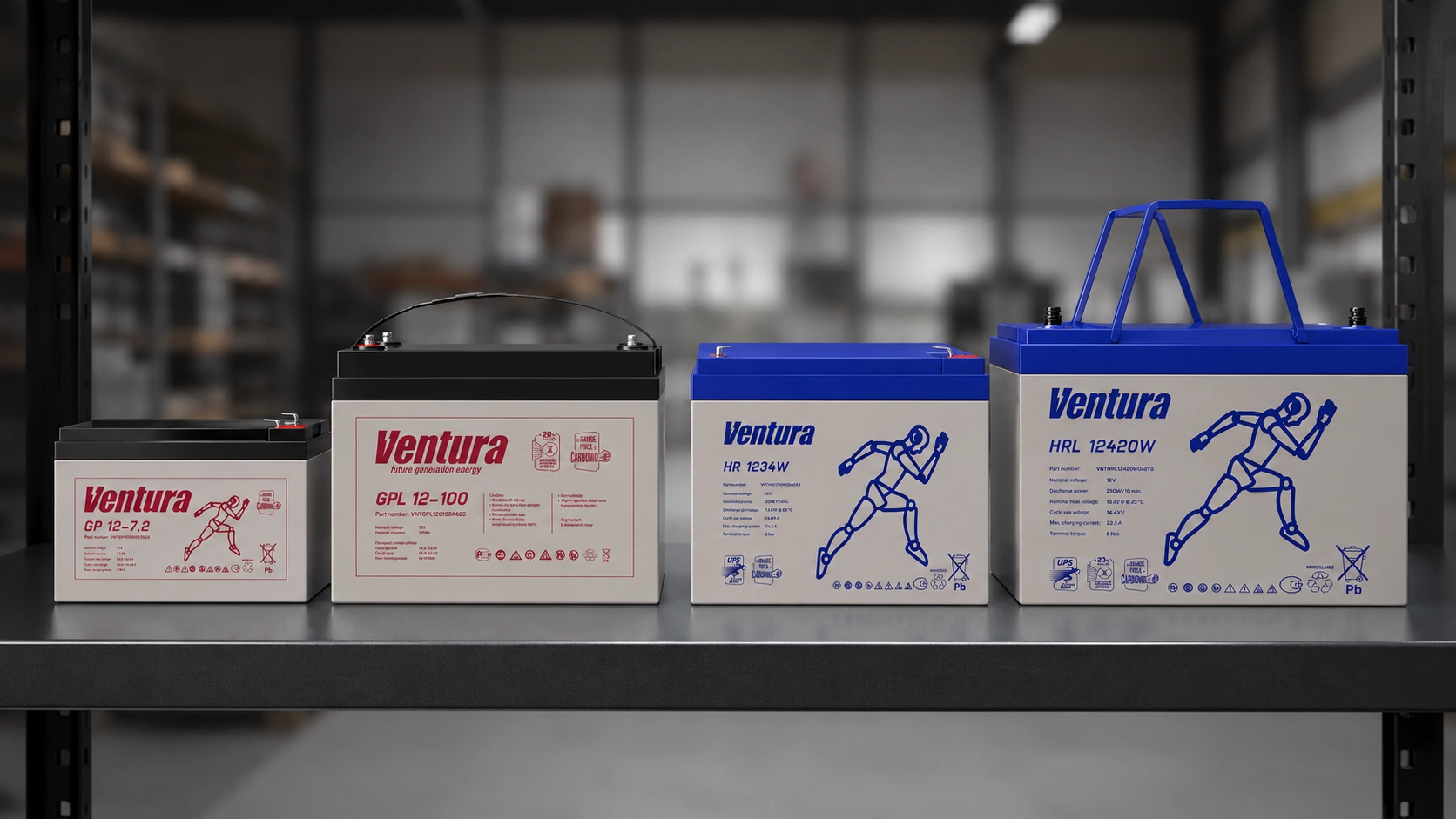
Ventura Battery offers several series of AGM batteries for different backup and autonomous power modes: from compact batteries for security systems to high-power solutions for industrial UPSs and critical infrastructure. All series are made using AGM technology: the electrolyte is retained in a fiberglass separator, so the batteries do not require maintenance, are suitable for permanent installation and are designed to operate in float mode or in short-term high load scenarios.
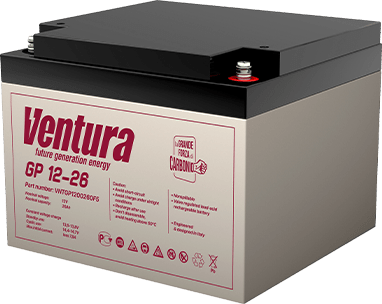
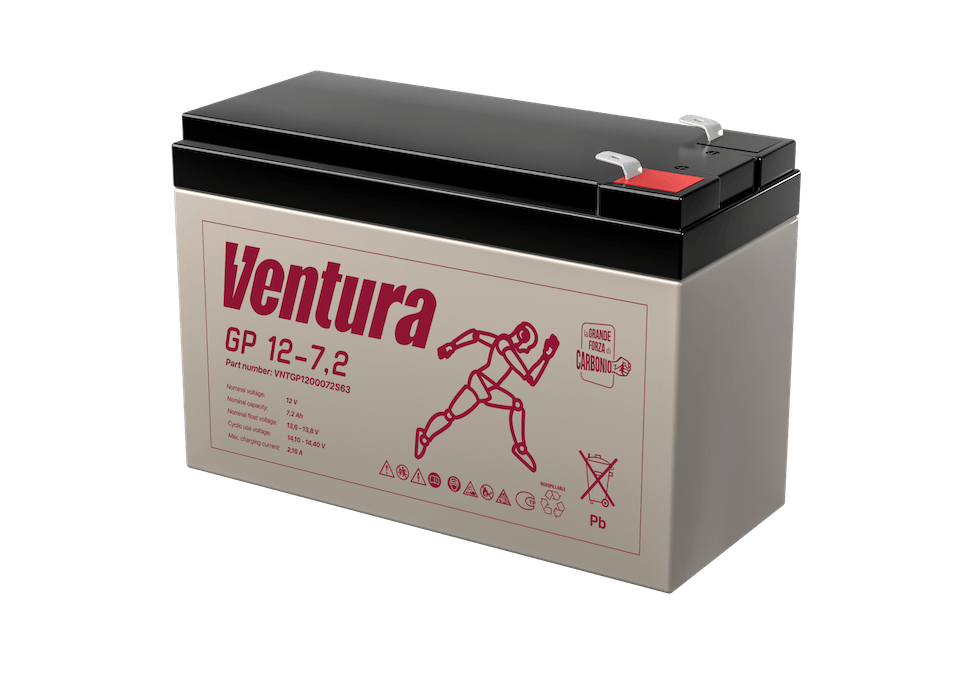
Ventura GP is a basic line of universal maintenance-free AGM batteries for general purpose. The series is designed for a nominal voltage of 12 V and includes models with a capacity of up to 100 Ah. GP are optimal for commercial and household UPS of small and medium power, security and fire systems, video surveillance, access control systems, cash register equipment, autonomous power supply of country houses and other objects where compactness, stable operation and low self-discharge are important. Batteries in this series can be used both in float charging mode and in moderate cyclic mode.
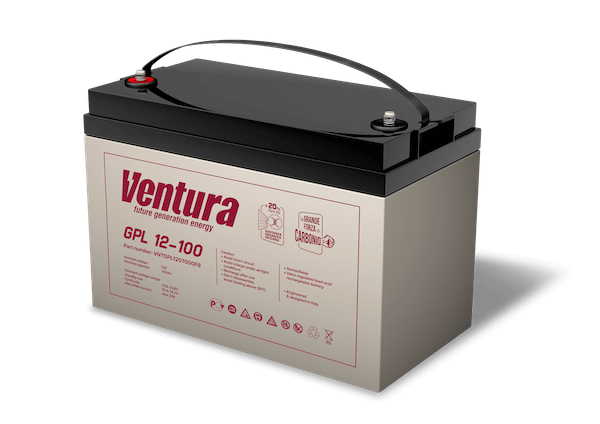
Ventura GPL is an expanded series of general purpose AGM batteries with an extended service life. The line is designed for 12 V voltage and includes models with capacities up to 250 Ah. Compared to the basic GP, the GPL series is aimed at more critical backup power systems: industrial UPSs, telecommunications equipment, server rooms, banking and engineering infrastructure. Thickened plate grids, increased corrosion resistance and technological additives in the active mass help increase battery life and maintain stable performance over long-term operation.
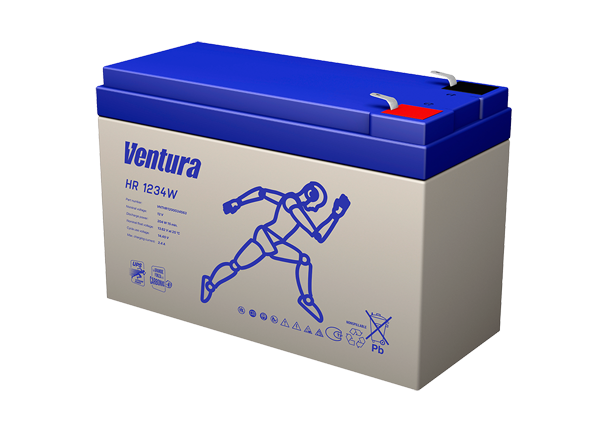
Ventura HR is a series of maintenance-free AGM batteries with high current characteristics. These batteries are designed for 12V voltage and are intended primarily for short discharge periods when equipment must receive a lot of power in a limited time. HR are used in uninterruptible power supplies, emergency power supply systems, telecommunications and industrial equipment. Due to reduced internal resistance, an increased number of plates and special additives in the active mass, HR batteries provide reliable current output at peak loads.
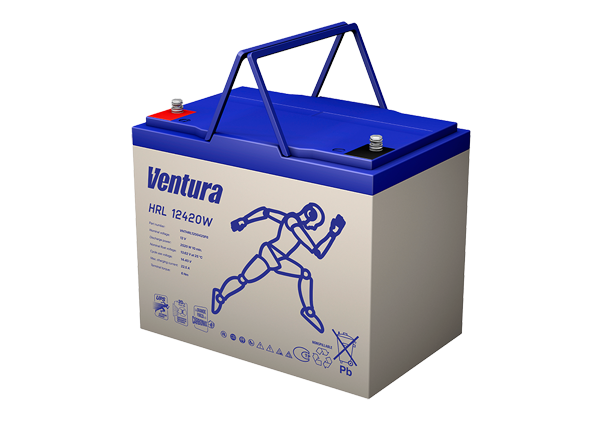
Ventura HRL is a high-power AGM series with extended service life for large backup power systems. Like HR, HRL batteries are designed for short discharge modes, but have an expanded model range and a longer service life. The series is suitable for data centers, high-power UPSs, communications facilities, industrial energy, medical and financial infrastructure - where high power over a short interval and increased reliability of the battery bank are required. Increased thickness plates, GFC and SOI technologies, impact-resistant ABS housing and low self-discharge make HRL the optimal choice for critical facilities with increased requirements for the quality and stability of power supply.
|
Series |
Typical purpose |
Key Feature |
Main Applications |
|
Ventura GP |
Universal backup power |
Basic general purpose AGM series |
Low and medium power UPS, alarm system, video surveillance, access control system, cash register equipment |
|
Ventura GPL |
Long-term operation in critical systems |
Extended service life and expanded model range |
Industrial UPS, telecom, server rooms, banking and engineering infrastructure |
|
Ventura HR |
Short discharge modes with high load |
High power and current output |
UPS, emergency power, telecommunications and industrial equipment |
|
Ventura HRL |
Powerful critical systems |
High short-discharge power and extended service life |
Data centers, large UPS, communications, energy, medicine, financial infrastructure |
This set of series allows you to select an AGM battery not only by voltage and capacity, but also by operating mode. GP solves most standard power backup applications, GPL is chosen where extended service life is needed, HR is suitable for systems with high short-term currents, and HRL is suitable for large and mission-critical applications where a combination of power, service life and reliability is required.
Conclusion
AGM batteries are a technologically advanced and proven solution for a wide range of industrial, infrastructure and commercial applications. AGM is not just an acronym, but a specific design principle: the electrolyte is absorbed by a fiberglass mat, the battery does not require topping up water, provides high current output and is suitable for various configurations of backup power systems.
Competent selection of batteries based on voltage, capacity, type of terminals, operating mode and operating conditions is the key to achieving the specified service-life targets and efficiency of the system as a whole.
Frequently asked questions
AGM battery - what does it mean in simple words?
AGM is a type of sealed lead-acid battery in which the electrolyte is absorbed by an Absorbent Glass Mat. This design means that the battery does not require topping up water, emits a minimum of gases during normal operation and can be installed in different positions if the manufacturer allows it (except for the position with the terminals facing down). AGM batteries are used in UPSs, security systems, telecommunications units and industrial equipment.
Is AGM a gel battery or not?
First of all, we note that AGM and GEL batteries are traditional lead-acid batteries. Their work is based on the same chemical reactions as “classic” batteries, and the electrolyte is the same acid. But in maintenance-free batteries, the acid is, as mentioned above, in a bound state:
• in AGM batteries, the interelectrode space is filled with a microporous fiberglass separator material (hence the name Absorbent Glass Mat). The porous fiberglass acts like a sponge - it holds the acid and prevents it from spreading, even if the battery case is damaged.
• in GEL batteries, the electrolyte contains silicon dioxide (SiO2), which converts the acid into a gel-like mass (hence GEL - gel electrolyte).
No. AGM and GEL are different technologies in the VRLA (sealed lead-acid) battery class. In AGM, the electrolyte is absorbed by a fiberglass separator mat, in GEL/V-Gel it is thickened with silica gel. Both types are maintenance-free, but differ in current output, cycle life and optimal operating modes. This should be taken into account when designing the system.
Can an AGM battery be charged with a standard charger?
Not recommended. AGM batteries require a charger that supports the AGM/VRLA profile and the ability to precisely regulate the voltage. The use of household or outdated chargers without an appropriate algorithm reduces battery life. The optimal solution is professional chargers with the IUI algorithm and temperature compensation of voltage.
What is the service life of an AGM battery?
The service life of AGM batteries depends on the series, mode and operating conditions. For the Ventura GP series in float mode at +25°C – 5–7 years, Ventura GPL – 7–10 years, Ventura PRO – up to 10–12 years. For every 8–10°C increase in ambient temperature above +25°C, the battery life is reduced by approximately half, so the room temperature is one of the key parameters when designing a battery bank.
GP (General Purpose)
Learn more
GP
GPL (General Purpose Longlife)
Learn more
GPL
HR (High Rate)
Learn more
HR
HRL (High Rate Longlife)
Learn more
HRL