Uninterrupted Video Surveillance: Choosing the Right Battery


 6 min read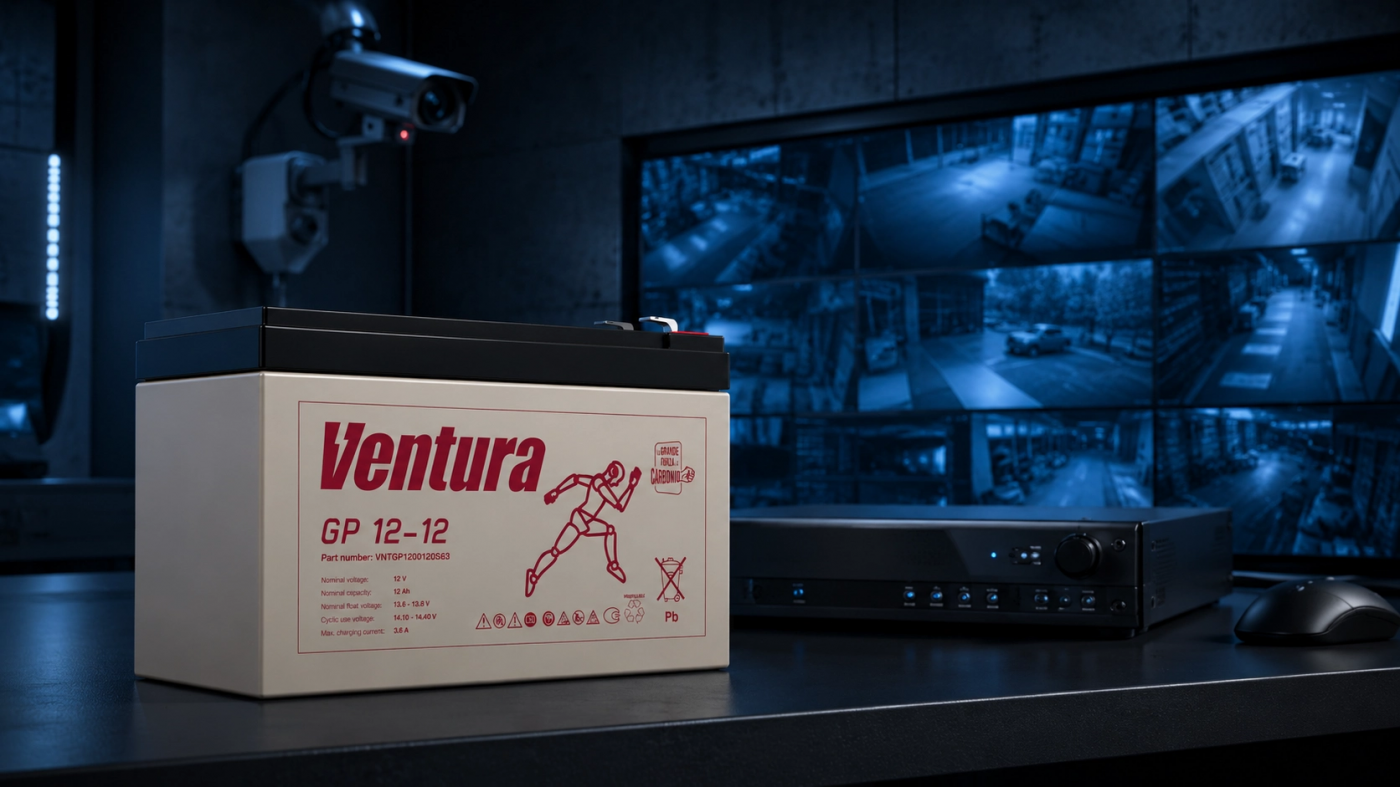
Stable and high-quality operation of a video surveillance system depends not only on the characteristics of the cameras and DVR, but also on properly organized backup power. At commercial, administrative and industrial facilities, the total load includes cameras, DVR/NVR, PoE switches, routers, drives and other network equipment.
Therefore, battery for video surveillance is chosen not only by capacity. The design takes into account the rated voltage, equipment power, battery technology, UPS characteristics, temperature conditions and required service life.
Why cameras turn off at the most inopportune moment - and how the battery saves video recording
Backup power ensures continuity of operation of cameras and associated equipment when the mains supply fails. Batteries work in conjunction with a UPS or a specialized backup power source, so the parameters of all components must be compatible with each other.
How backup power for a video surveillance system works
When mains power is available, the equipment receives energy from the main source, and the batteries are maintained in the charge mode specified by the manufacturer. When switching to reserve, their energy is used to power cameras, recorders and network equipment during the estimated runtime.
What equipment should continue to work with cameras
The calculation includes all the infrastructure necessary for the generation, transmission and storage of video information:
-
cameras;
-
DVR/NVR and storage devices;
-
PoE switches;
-
routers and modems;
-
additional network devices.
This approach allows you to select batteries for the entire video surveillance system, and not just for individual components.
Why a car battery is not suitable for video surveillance
For professional backup power, stationary batteries are used, designed for float or cyclic mode. Their design and discharge characteristics are aimed at long-term stable power supply of engineering equipment, while starter solutions have a different purpose.
An error in the capacity will leave cameras without recording - how to calculate the battery correctly
The battery capacity is determined by the total power consumption of the equipment and the required runtime. For preliminary calculations, it is necessary to know the load power, the voltage of the battery circuit and the safety factor provided for by the design.
How to determine the actual power consumption of the system
The power of the cameras, recorder, network equipment and auxiliary devices is summed up. For engineering calculations, operating or maximum indicators from technical documentation are used, especially if the equipment has several energy consumption modes.
Why IR, PTZ and PoE increase power consumption
Camera power consumption may increase when IR illumination, PTZ drives and additional functions are enabled. PoE systems also take into account the switch’s own consumption and the total load of its ports.
How to calculate battery capacity for video surveillance
For preliminary assessment use the formula:
C = P × T / (U × K),
where C is the required capacity, Ah, P is the total power of the equipment, W, T is the runtime, h, U is the battery voltage, V, K is a coefficient that takes into account the operational reserve and losses.
The obtained value is clarified using the technical characteristics and discharge tables of the selected model.
Example of battery calculation for four cameras and a DVR
Let's say four cameras, a DVR and network equipment consume 60 watts. At a voltage of 12 V, four hours of runtime and a coefficient of 0.8, the calculated capacity will be about 25 Ah.
With a design reserve of 20–25%, the guideline increases to approximately 30–32 Ah. Then the closest suitable model is selected and its characteristics are checked at the required discharge mode.
AGM, GEL or LiFePO4: which battery offers the right service life?
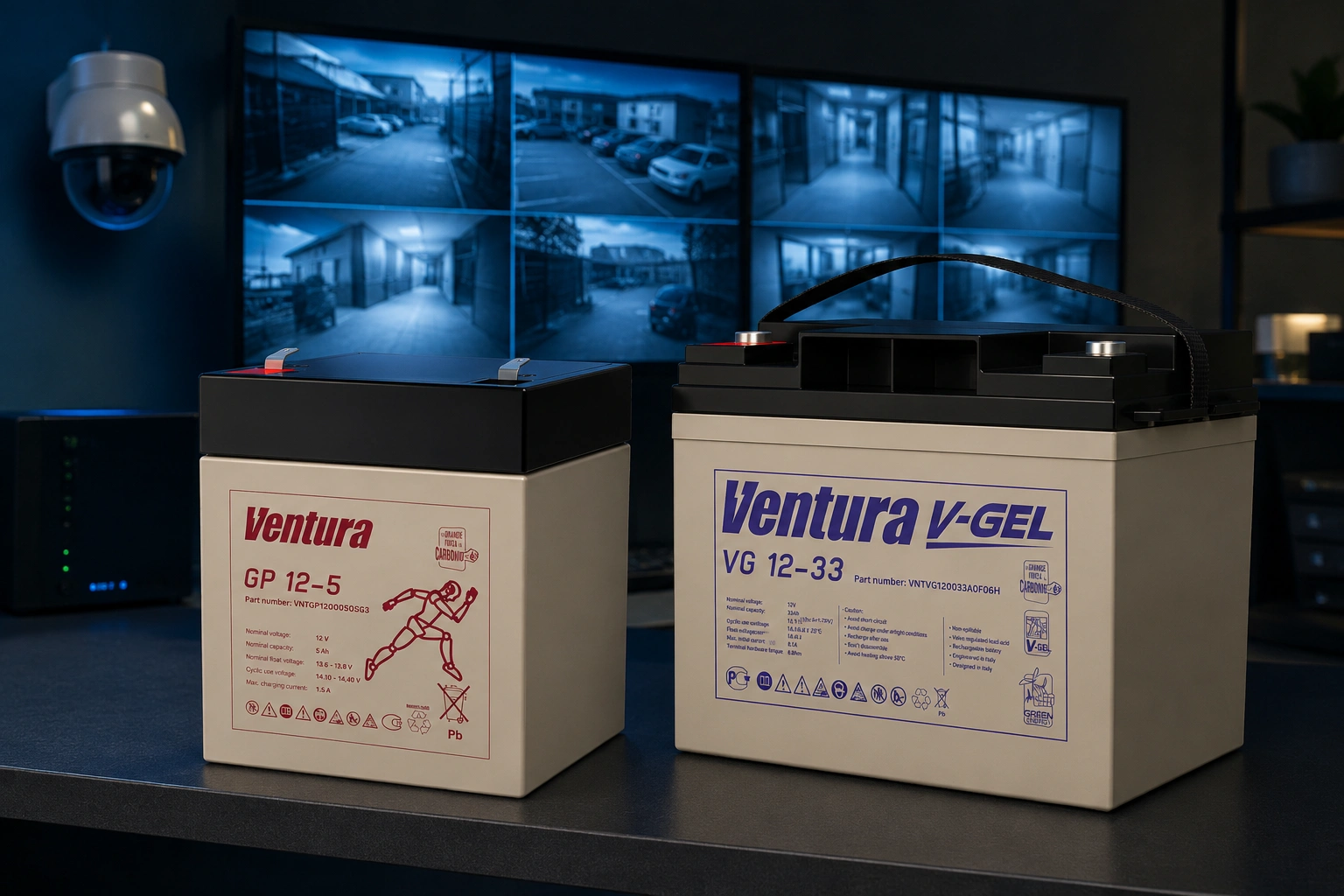
For security systems, sealed AGM and GEL/V-Gel batteries are most often used. The technology is selected depending on the operating characteristics, the frequency of autonomous operation and the required service life.
AGM – a practical option for standard power backup
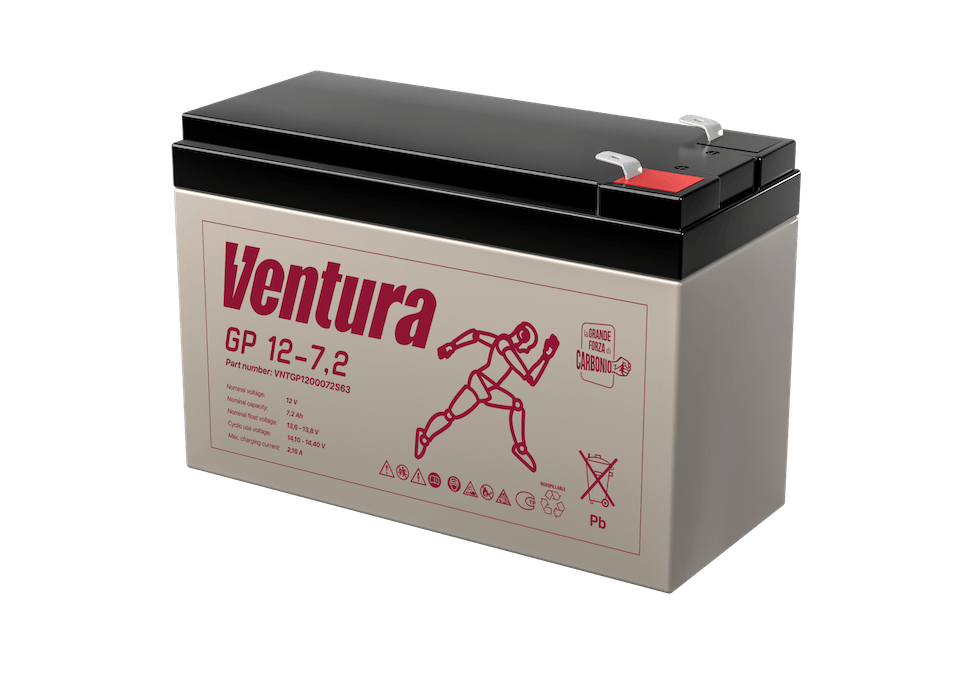
AGM batteries are well suited for backup power supply systems due to their low internal resistance, high energy density and ease of use, as they are maintenance-free. The Ventura GP series is designed for stationary use and includes models of different capacities for security systems, UPS and other equipment.
GEL – choice for frequent shutdowns and cyclic operation
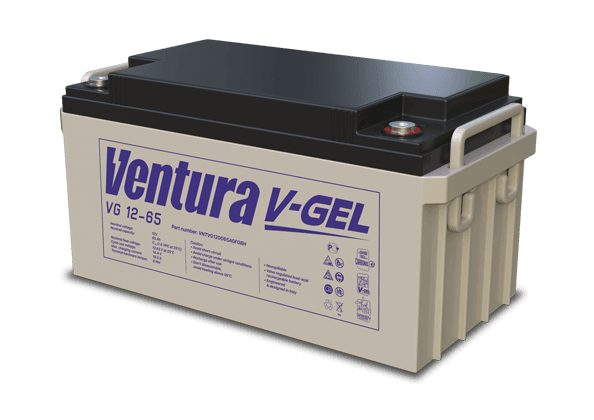
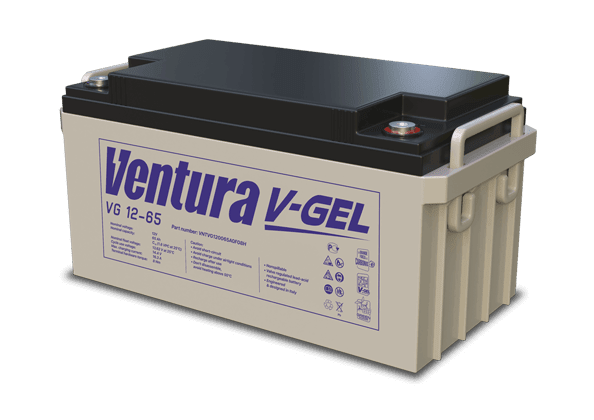
V-Gel batteries are suitable for facilities where, along with a float mode, an increased cycle life is required. The Ventura VG series is available with a nominal voltage of 12 V and a capacity from 33 to 250 Ah, and the service life of some models reaches 15 years.
LiFePO4 – when a high price can be justified
Lithium iron phosphate technology is used in specialized projects where high cycle life, compactness and low weight of the battery system are important. The UPS and charging equipment must support the appropriate charging algorithm.
How to choose a technology based on the frequency of outages
For classic backup power, AGM is often chosen. For more intensive cycling applications, V-Gel may be considered, and LiFePO4 is used in projects with special requirements.
|
Battery type |
Float mode |
Cyclic operation |
Maintenance |
Main Application |
|
AGM |
Optimal |
Suitable |
Not required |
UPS, cameras, security systems |
|
GEL/V-Gel |
Optimal |
Extended service life |
Not required |
Frequent operation on battery power |
|
LiFePO4 |
With compatible hardware |
High cycle life |
BMS |
Specialized projects |
12 V and more. Which battery parameters cannot be ignored
Rated voltage and capacity are two of the selection criteria. For accurate selection, the current characteristics, discharge mode, service life, dimensions, weight and type of battery terminals are also taken into account.
Battery voltage
Compact systems often use 12 V batteries. For battery buses of 24, 48 V and above, several identical units are combined according to UPS requirements and system design.
Discharge current and peak load
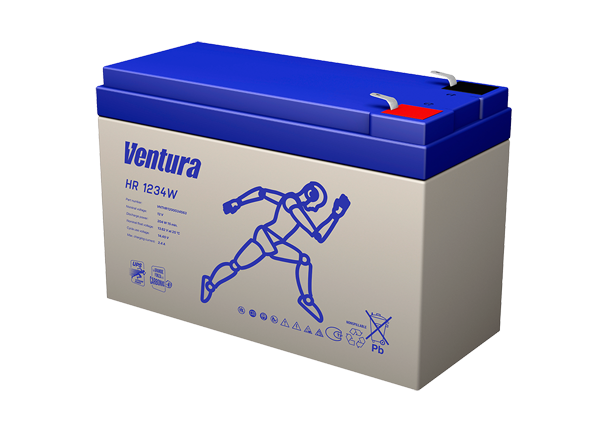
The same ampere-hour capacity does not mean the same power over a short period. For UPS with high load, power and internal resistance are important. For example, the Ventura HR 1234W has a voltage rating of 12V, a capacity of 9.1Ah at C20, and a power output of 231W per unit in 15-minute mode.
Service life and cycle life
The service life depends on the design and purpose of the series. For Ventura GP, a service life of 6–9 years is stated, the HR series is designed for a period of at least 10 years, and V-Gel VG is up to 15 years, subject to the operating conditions specified by the manufacturer.
Discharge depth
The depth of discharge affects the available backup duration and cycle life. Therefore, when designing, the necessary reserve capacity is provided and the series is selected in accordance with the actual operating mode of the system.
Dimensions, weight and type of terminals
Before selection, check the dimensions of the battery compartment, weight and type of terminals. The Ventura lines use different terminal designs, which allows you to select a model for a specific UPS or battery cabinet.
Frost, heat and rain can eat away at backup duration - what to check before installing the camera
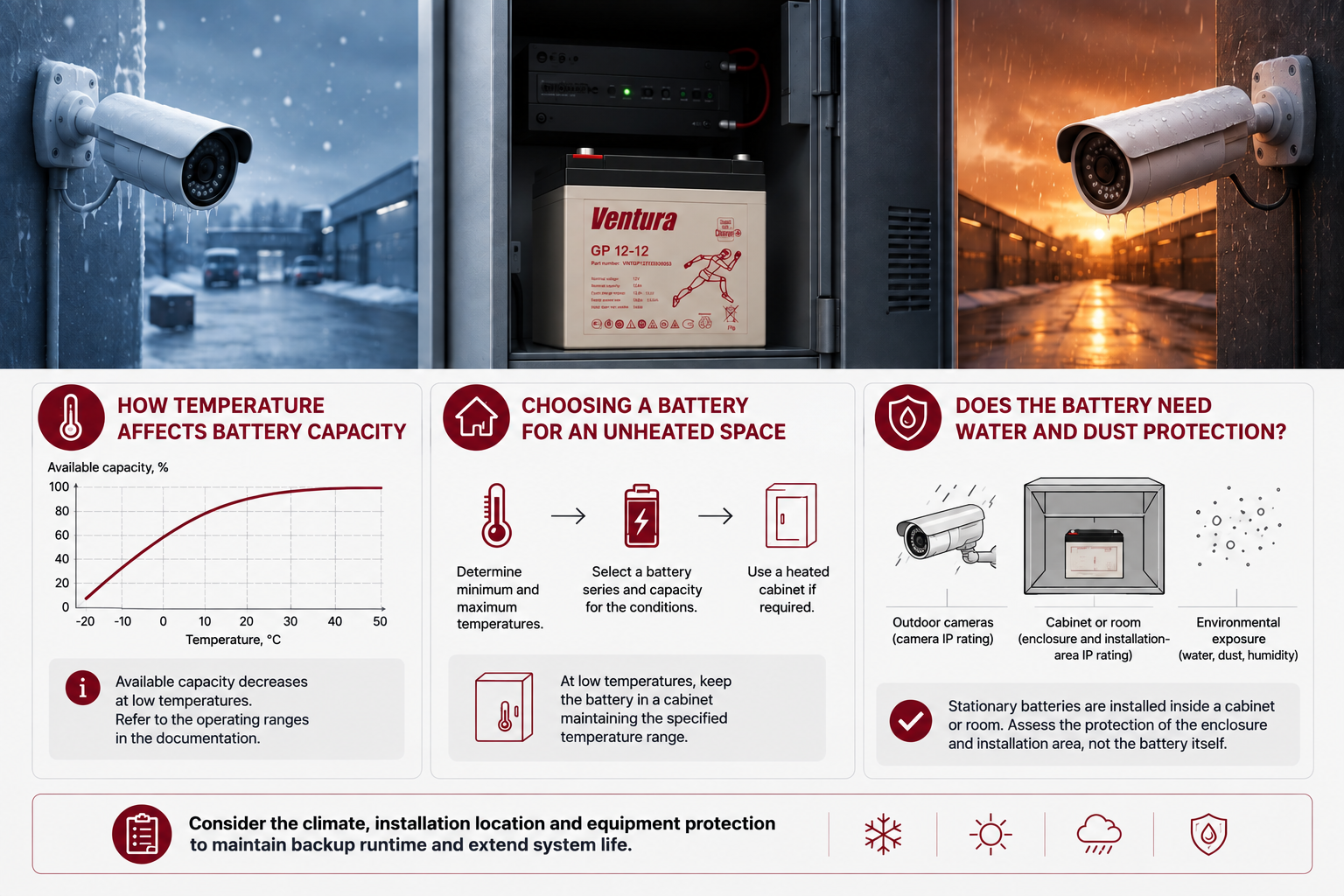
Temperature conditions affect the available capacity and battery life. For technical cabinets, checkpoints, warehouses and other objects, it is necessary to take into account the actual temperature range at the installation site.
How temperature affects the available battery capacity
Battery ratings are determined at a given temperature, so as conditions change, the actual capacity also changes. For a specific project, you should focus on the operating ranges specified in the technical documentation of the selected series.
How to choose a battery for an unheated room
First, the minimum and maximum temperatures in the installation area are determined, after which the series and capacity are selected. If necessary, batteries are placed in a separate technical cabinet with the temperature regime specified by the project.
Does the battery need protection from water and dust
Stationary batteries are usually installed inside equipment, a cabinet or a prepared room. Therefore, the IP rating is assessed for the housing and installation area, and the parameters of external cameras and the battery system are considered separately.
Which uninterruptible power supply to choose for video surveillance
The UPS and batteries form a single backup power system. When selecting, it is necessary to coordinate the load power, battery circuit voltage, charging current, battery technology and battery life.
UPS 12 V, 24 V or 220 V - which option does the system need
DC sources are used for equipment with the appropriate input voltage, and AC-UPS make it possible to back up a set of devices with a 220 V power supply. The specific architecture is determined by the composition of the cameras, recorder and network infrastructure.
How to calculate the power of a UPS
The power of the source must exceed the total consumption of the connected equipment and take into account the design margin. In this case, the UPS power in W or VA and the battery capacity in Ah are calculated separately.
Why should the UPS charging current match the battery capacity
The capacity of the battery system must match the capabilities of the built-in charger. When selecting, take into account the charge voltage recommended by the manufacturer and the permissible charging current.
Why battery technology must be compatible with the charger
AGM, V-Gel and lithium batteries have different charging requirements. Therefore, the UPS specifications are first checked and then a compatible battery technology is selected.
How to choose a battery for a CCTV camera and not overpay for extra capacity
You can choose a battery for a video surveillance camera after determining the actual load and battery life. The optimal battery must match the system power, the capabilities of the UPS and the intended operating mode.
Battery for one camera
For local installations, take into account the maximum power of the camera and equipment required to transmit or record the image. If PoE or a separate router is used, their power consumption is also included in the calculation.
Battery for several cameras and a DVR
In a multi-camera system, the load of cameras, recorder, storage devices and network infrastructure is summed up. After this, the required runtime is set and the required battery capacity is determined.
Battery for a system with PoE
In the PoE configuration, the power source for the cameras is reserved - a PoE switch or NVR with the corresponding ports. The calculation is performed based on the total power of connected devices.
Conclusion: choosing the optimal battery
The selection of batteries for video surveillance begins with calculating the full load and the required runtime. Next, the battery circuit voltage, technology and specific series are determined, checking the result against the manufacturer’s technical specifications.
Short battery selection algorithm
When designing, it is convenient to follow five steps:
-
determine the total power of the equipment;
-
set the required runtime;
-
calculate the required capacity;
-
select battery voltage and technology;
-
check the compatibility of the batteries with the UPS and installation conditions.
This algorithm is suitable for both several cameras and a distributed security system for a large facility.
When is it better to entrust the calculation to a specialist
Selection with the participation of an engineer is especially relevant for systems with a large number of cameras, long backup duration, PoE infrastructure and 24 or 48 V battery circuits. Ventura specialists can help select the series, configuration and technical documentation for the parameters of a particular facility.
Frequently asked questions
Which battery is best for video surveillance?
What battery capacity is needed for a CCTV camera?
How many hours does the video surveillance battery last?
Can a car starter battery be used for video surveillance?
Which is better for video surveillance - AGM or GEL?
How often should you change the battery in a video surveillance system?
How to check the CCTV battery?
Which uninterruptible power supply should you choose for video surveillance?
GP (General Purpose)
Learn more
GP
HR (High Rate)
Learn more
HR
VG (Gel Viscoso)
Learn more
VG