Battery polarity: what it means and how to avoid mixing up the terminals


 3 min read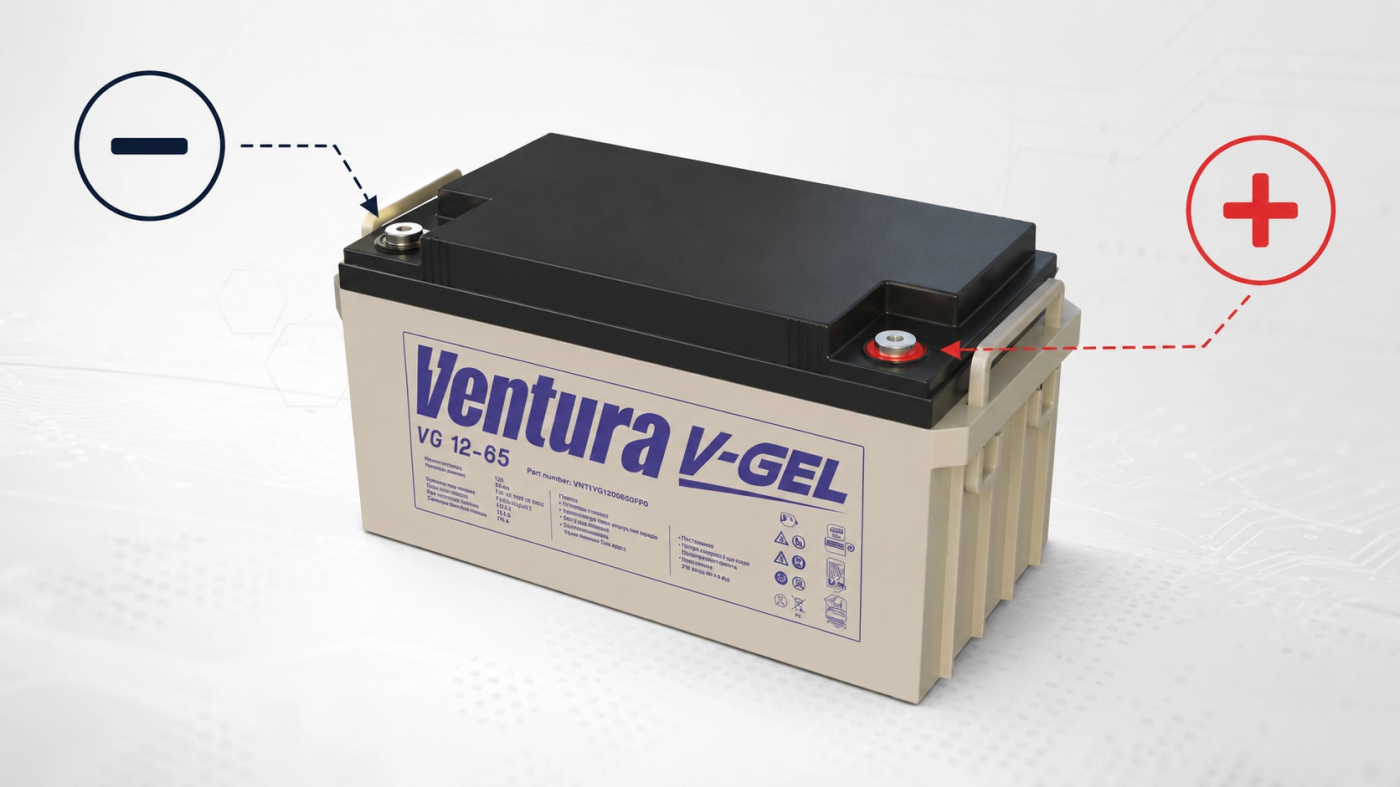
Polarity is the location of the plus (+) and minus (-) terminals on the battery body and their correspondence to the wires of industrial equipment, machinery, vehicles, instruments and other devices. Incorrect polarity when connecting can lead to a short circuit and damage to the electronics, so it must be determined before installing the battery.
What does battery polarity mean?
Battery polarity is the arrangement of the positive (+) and negative (−) terminals on the battery body.
Every Ventura batteries has 2 terminals: positive “+” (usually red, larger diameter) and negative “-” (black, smaller diameter). Polarity demonstrates where the “+” is physically located relative to the “-” and is indicated on the battery case.
Polarity marking is carried out in accordance with the requirements of GOST R IEC 60095-2 or GOST R IEC 60095-4.
What types of battery polarity are there: forward and reverse?
There are two options for battery polarity:
- Straight polarity. Position the battery with the terminals facing you: if the “+” is on the right, the polarity is straight.
- Reverse polarity. With the same orientation, if “+” is on the left, it’s the opposite.
There are different standard sizes and terminal designs (SAE/JIS, bolt terminals for traction and UPS models), but the principle of determining polarity is the same.
How to determine battery polarity?
Look at the markings on the cover: “+” and “-” must be applied with paint or thermal seal. To accurately determine polarity:
- Place the battery with the terminals facing you and secure where the “+” is on the right or left.
- Check with the previously installed battery: the length of the standard wires is designed for a specific polarity.
- If in doubt, measure the voltage with a multimeter. The red probe is to the supposed “+”, the black one is to “-” (should be ~12.6-12.8 V for a fully charged 12V battery).
Differences between direct and reverse battery polarity
For clarity, we have collected the main differences between direct and reverse polarity of batteries in the form of a table.
| Sign | Straight polarity | Reverse polarity |
|---|---|---|
| Orientation for inspection | Terminals to yourself | Terminals to yourself |
| Location "+" | Right | Left |
| Marking in catalogs | Most often "R" (Right +) | Most often "R" (Right +) |
| Harness compatibility | Corresponds to a layout where the positive wire runs to the right | Corresponds to a layout where the positive wire runs to the left |
The terminal layout is shown in the figure

What happens if you reverse the polarity of the battery when connecting?
Before connecting the battery, be sure to ensure that the polarity is correct. If there is an error, the equipment may not only fail to start, but also fail. Possible consequences of mixed terminals:
- Damage to components and assemblies. Blown fuses, generator diode bridge, control units, chargers.
- Sparking and local overheating. Damage to terminals, melting of insulation, risk of fire.
- Negative chemical processes. Accelerated corrosion of terminals and connections.
How to avoid mistakes when determining and connecting battery polarity: 4 recommendations
Before installing the battery:
- Compare the polarity of the new battery with the old one;
- Check the “+”/“-” markings on the housing;
- Do not pull the wires through the case, take the battery with the correct polarity;
- When connecting, first connect “+”, then “-”, and when removing - vice versa (first “-”).
The main rule: hold the battery with the terminals facing you and look at the “+”. If it is on the right, then the polarity is direct, if on the left, then it is reversed. This approach allows you to quickly determine the type of battery you need and eliminate errors during replacement.