Choosing a UPS battery: how to select the right battery


 8 min read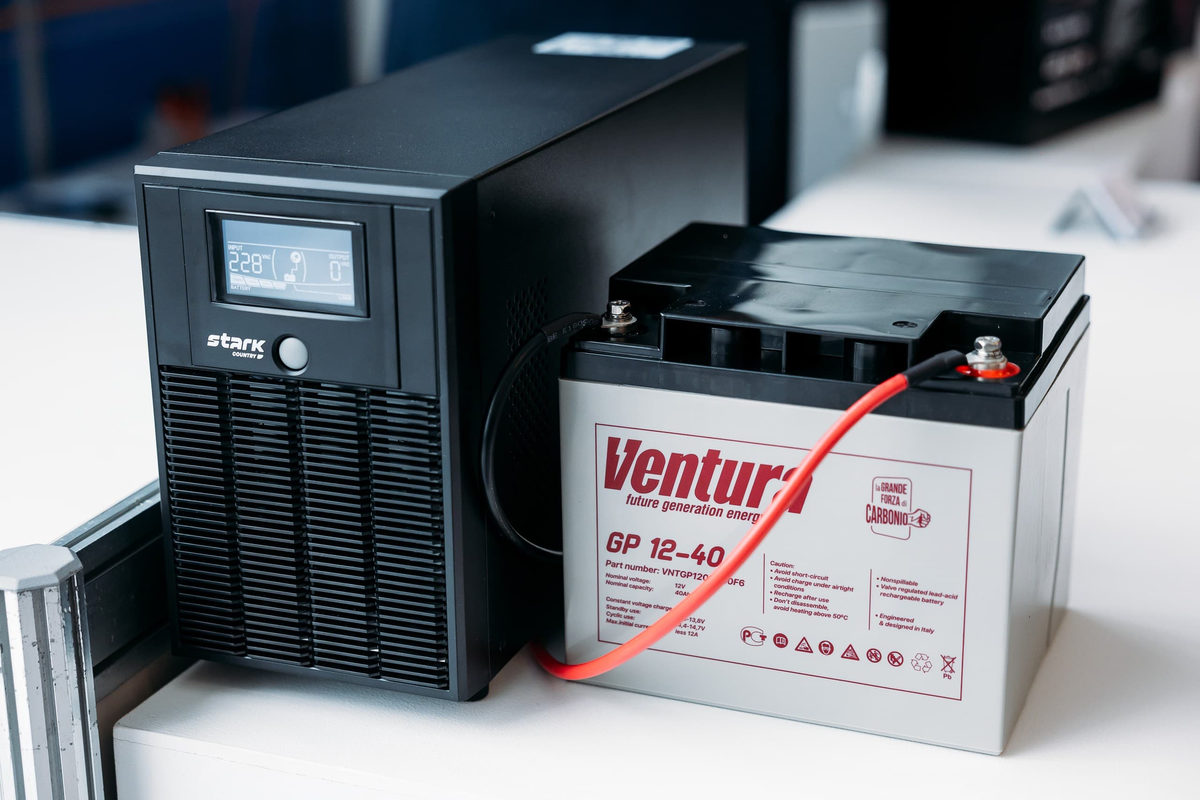
The reliability and service life of an uninterruptible power supply is largely determined by a properly selected battery. We will understand what types of batteries are used with a UPS, how to estimate the required capacity and battery life, and in which cases to choose AGM or GEL batteries.
What type of batteries are used with a UPS and why
Most UPSs use two types of VRLA batteries:
- AGM (Absorbent Glass Mat). The electrolyte is absorbed into a fiberglass separator. Advantages for UPS: high current output at short intervals (10-30 minutes), low internal resistance, tightness. Regular monitoring of connections and parameters is required, as well as precise settings of the charger in accordance with the series data sheet.
- GEL (Gelled Electrolyte). The electrolyte is thickened. It has greater resistance to deep discharges and elevated temperatures, and a higher service life in cyclic modes. At the same time, the permissible charge and discharge currents are usually lower than those of AGM.
The industrial segment and corporate infrastructure also use lithium-ion (Li-ion/LiFePO4) batteries with a standard control system. They provide greater specific energy and resource, but require compatibility in protocols and settings of the charger/UPS, as well as compliance with increased safety measures during storage and operation.
What battery capacities are commonly used in UPS systems?
The selection of battery capacity for a UPS depends on the class of the device, the required autonomy and the method of battery placement. Typical ranges can be used as a guide:
- Low-power household and office UPSs - as a rule, one 12-volt monoblock 7-9 Ah (sometimes 12 Ah) is placed inside the case.
- Medium power UPS - external battery modules based on 12V monoblocks 26-400 Ah are used. For 24/36/48V, series circuits are formed.
- Rackmount and 48V telecom systems use 12V batteries with front terminals (easy front access), typically 26-150 Ah, connected in series in a circuit.
- Long reserves (several hours) - requires increased total capacity due to parallel circuits or the use of stationary lead-acid batteries with gel electrolyte, or lithium cabinet modules.
How to choose battery capacity for a UPS
The capacity is selected taking into account the required autonomy and load power:
- Determine the active power of the load in watts and the desired battery life. For servers, focus on average actual consumption, and not on the rating of the power supply.
- Consider the efficiency of the uninterruptible power supply. In most cases it is 85-95%. To calculate autonomy, allow for losses.
- Consider the discharge mode. For 10-15 minute reserves, high-current AGM batteries are needed. Their actual output at high currents is higher than that of general purpose batteries of the same rated capacity. For hourly and longer reserves, it is advisable to use AGM series designed for long discharge intervals.
- Use the manufacturer's bit tables. They indicate what current and power the battery can supply for n minutes up to a given final voltage at 25°C. This is more reliable than recalculating ampere hours alone.
- Provide a temperature correction and reserve. At lower temperatures, the available power is reduced. A reserve of 10-20% of the calculated minimum is recommended.
- Check the charger's limitations. Make sure that the UPS is capable of correctly charging the selected total capacity (current and voltage, with temperature compensation).
Battery for uninterruptible power supply: GEL or AGM
The choice of battery type for a UPS is determined by the required autonomy, temperature and peak currents. AGM (High-Rate) is a standard for UPS. Preferred for short and medium reserves where high discharge currents and fast recovery are required. Compatible with most standard UPS charging profiles.
It is advisable to choose GEL for long battery life, elevated temperatures and regular cycles. In such batteries, the permissible charge and discharge currents are lower; precise setting of charge voltages is required (usually lower than that of AGM).
If the UPS and infrastructure support lithium-ion batteries, this option provides the highest energy intensity per unit volume and long service life, but requires full compatibility with BMS and communication protocols.
Instructions for selecting a battery for a UPS
Step-by-step instructions on how to choose a battery for an uninterruptible power supply:
- Collect initial data. Uninterruptible power supply model, actual load power, required battery life, operating conditions (temperature, ventilation, access).
- Determine the nominal voltage of the battery pack. This can be 12/24/36/48V - according to the requirements of your UPS. The number of batteries connected in series depends on this.
- Select your battery type. AGM High-Rate battery - for short and medium battery life. GEL battery - for long battery life and elevated temperatures. Lithium-ion battery - with priority to compactness and resource, with full compatibility with uninterruptible power supply and the use of special fireproof cabinets
- Check the bit tables of the selected series. Find the parameters for the desired duration (10, 15, 30, 60 minutes, etc.) and final voltage at 25°C.
- Compare the charging settings with the series data sheet. It is important to take into account the voltage of cyclic and buffer modes, current limitation, and temperature compensation.
- Consider installation and maintenance. Batteries with front terminals are convenient for racks. Provide access to terminals, equal cable lengths, and separate protection for each series circuit.
- Provide reserves and the ability to scale. Provide a reserve of power and autonomy time or the possibility of adding a parallel circuit as the load increases.
Where to buy UPS batteries
Our catalog contains lines of UPS batteries - AGM High-Rate and 12-volt batteries with front terminals for 48-volt racks, as well as models for long battery life. Datasheets and bit tables are available for selection, and technical support is available for compatibility and charging settings. You can get advice and arrange a wholesale supply by filling out the form below or retail in the “Where to buy».