Backup power for healthcare facilities: requirements and solutions


 11 min read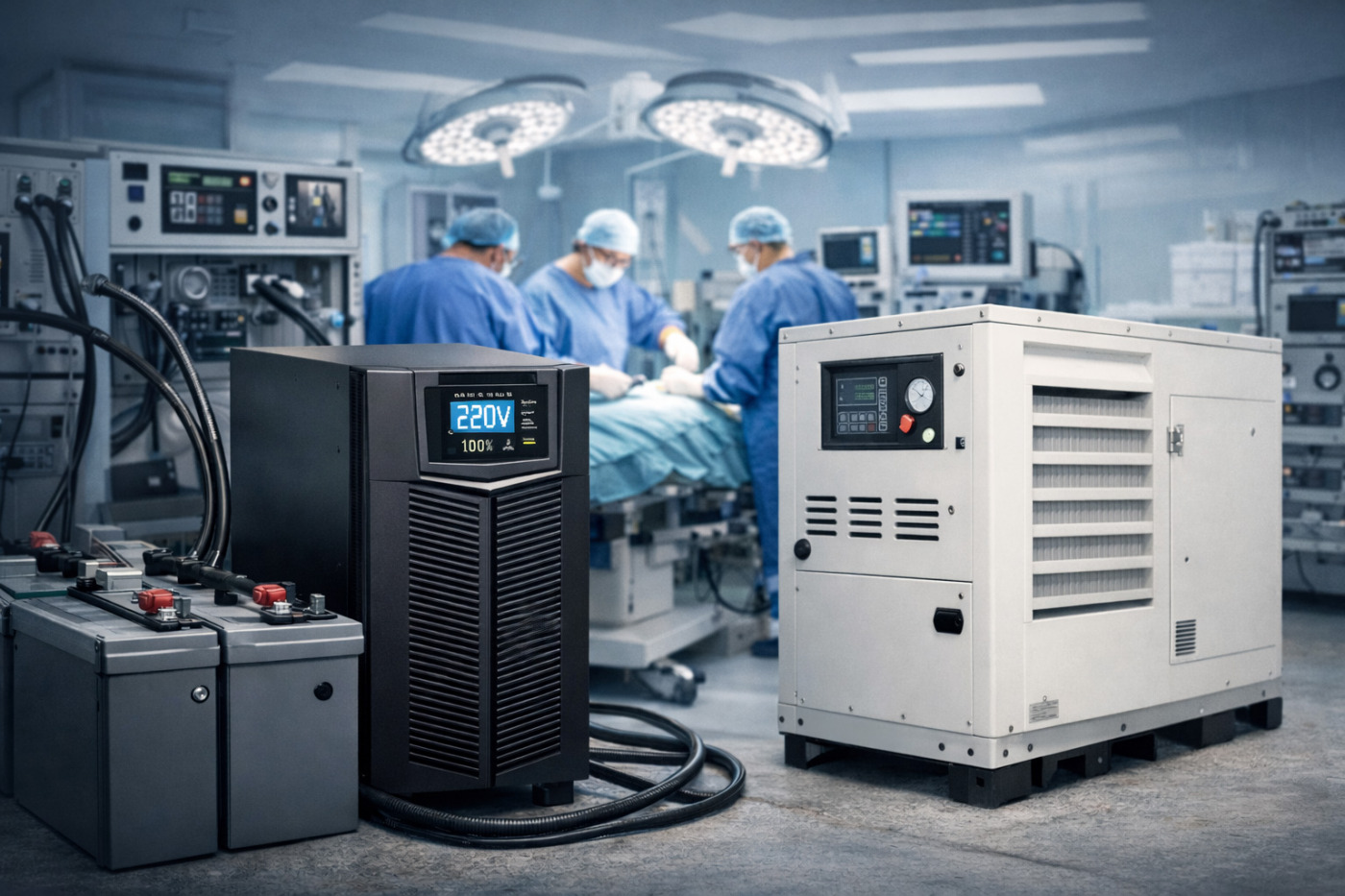
Reliable power supply for a medical facility is a basic condition for its safety. Any power outage affects the life and health of patients, the work of staff, and the safety of equipment and data. In this article we will consider the requirements for uninterruptible power supply, the choice of a UPS and the principles of constructing a backup power supply system for a hospital or clinic.
Why is power backup critical for healthcare facilities?
Dozens of types of equipment operate simultaneously in hospitals and diagnostic centers: anesthesia machines, patient monitors, ultrasound, endoscopic stands, laboratory analyzers, MIS/PACS servers, communication systems. For some of these devices, a power outage is not acceptable even for seconds. Not only life support devices are critically important, but also infrastructure: operating room lighting, data networks, ventilation, fire automatics.
The backup power supply provides:
- continuity of processes (operations, resuscitation, invasive procedures);
- correct completion of operations on equipment that is not designed to operate without power supply;
- preventing damage to expensive devices due to sudden shutdowns, power surges and restarts.
Regulatory requirements for emergency power systems
Requirements for emergency power systems in medical institutions are regulated at the legislative level:
- The division of medical premises into groups 0/1/2, as well as the requirements for additional potential equalization and the use of medical IT networks with insulation monitoring are established by GOST R 50571.28 (IEC 60364-7-710).
- A mandatory condition for the use of emergency and evacuation lighting devices for operating rooms, intensive care units, maternity and other critical rooms is specified by SP 158.13330 with reference to SP 52.13330.
- The power supply reliability category for medical organizations is defined as I (for a number of premises - “I special”). Power must be provided from two independent sources with automatic reserve input in accordance with 7 PUE 6-7_2008_s amended. and additional
- For critical medical loads, it is recommended to use a VFI (online, double conversion) UPS according to IEC 62040-3 so that the output voltage and frequency are independent of the external network parameters.
- Requirements for the composition and updating of design documentation for sections of power supply and emergency lighting during new construction and reconstruction are enshrined in SP 158.13330 (taking into account current changes).
Main backup power sources
Before selecting backup power sources, set three initial parameters:
- Frequency and duration of possible network outages.
- What battery life is required without external power.
- Which areas of the institution are considered critical.
On this basis, a backup power architecture is formed, which includes several different devices.
UPS (uninterruptible power supply)
For clinical loads, a VFI class UPS is used - double conversion. Permanent inversion provides stable voltage and frequency, galvanic isolation from network interference and instant response to a power failure. The battery operating time is set based on the scenario: from several minutes (bridge to the start of the diesel generator set) to tens of minutes/hours for individual devices.
DGS (diesel generator set)
Provides long-term power backup (hours/day). Introduced through AVR, serves vital consumer groups. Medical buildings, as a rule, provide diesel generator sets with power and fuel reserves.
Energy storage systems
For tasks with frequent network failures or acoustic/environmental restrictions on diesel generator sets, storage cabinets with lithium-ion batteries (LiFePO) are used4) as a stand-alone or hybrid unit.
The elements in the backup power system are combined. The UPS provides instant continuity of power supply, the battery provides autonomy until the diesel generator starts, and then the generator operates.
How to choose a UPS for medical equipment?
The selection of an uninterruptible power supply begins with determining the clinical loads and requirements for power supply quality. It is important to consider the following parameters:
- Class and type. For critical areas (operating rooms, IT racks MIS/PACS, laboratory analyzers) double conversion (VFI/online) is required. For the second line (offices, archives), linear-interactive solutions are acceptable if permitted by the project.
- Power and overload capacity. The UPS must confidently withstand starting currents and short-term overloads (pumps, compressors, tomography racks) without switching to bypass.
- Time for autonomy. For a bridge before the introduction of a diesel generator set, the required autonomy time is usually 10-15 minutes. For individual devices (measurement, correct completion of the cycle) - 30-60 minutes or more.
- Leakage current and insulation compatibility. Medical devices often have high leakage currents. UPS and other devices must comply with insulation and monitoring requirements (medical IT power supply systems, transformers, insulation monitoring).
- Scalability and reliability. For maximum system protection and safety, use parallel operation of the UPS and N+1 circuits. Modular racks with hot-swappable components are preferred.
- Operation. Evaluate the availability of components for service (filters, fans, terminals), the availability of network monitoring with logs, as well as clear battery regulations (temperature, replacement, charging settings).
Scheme of building a backup power supply system
The architecture of the backup power supply system depends on the area, profile of the medical institution and budget, but the basic principles are the same:
- Two inputs. If technically possible, the building is connected to two independent inputs of the external network.
- Set automatic reserve input with priority of the main input and fast automatic switching.
- UPS of critical lines. Critical loads are supplied via a VFI class UPS. Typically these are separate rack or cabinet units by zone.
- Battery packs. The battery capacity is selected for the required autonomy time; internal or external units with access for maintenance are used.
- DSU. The diesel generator starts automatically, is introduced with a delay and is synchronized by frequency and voltage.
- Distribution by category. The network is divided into groups “vital”, “important” and “auxiliary” with separate switchboards, selective circuit breakers and metering.
- Medical IT networks. For rooms of group 2, an insulating transformer, insulation monitoring and a potential equalization system are used.
- Monitoring. Includes UPS and diesel generator dispatch, battery telemetry and emergency alarm system.
Power supply requirements for different areas of a healthcare facility
Internal power supply is divided into zones with different levels of requirements:
- Critical zones (group 2): operating rooms, intensive care, delivery, catheterization. Requires double conversion UPS, medical IT power systems (isolation), N+1 redundancy where necessary. The goal is continuity and patient safety.
- Important areas (group 1): diagnostic (CT/MRI according to the project), laboratories, sterilization rooms, IT counters (MIS, PACS archive). Protection against power supply interruptions and the quality of the sinusoid are required; the autonomy time is determined by the characteristics of the equipment.
- Auxiliary areas: registries, offices, warehouse, household premises. Simplified solutions are acceptable provided that this does not affect the clinical process.
This zoning makes it easier to calculate the power of sources, select batteries and check selectivity.
Maintenance and regular checks
The reliability of the system depends not only on the equipment, but also on how correctly it is operated. Therefore, it is extremely important to perform its maintenance correctly:
- Planned work. Inspection and cleaning, checking fans, measuring battery parameters (voltage/internal resistance), tightening terminals, updating controller software, checking alarms.
- Testing. Periodic functional tests: simulating a shutdown of a stationary network with control of the transition to autonomous mode, checking the battery life, starting a diesel generator set under load. Reports are recorded in a journal.
- Temperature regime. For batteries, adhere to the recommended temperatures (usually 20-25 °C). Overheating accelerates degradation, cold reduces available capacity. For diesel generator sets - control of cooling and fuel systems.
Conclusion
For a medical institution, it is critically important to organize the backup power system correctly: divide the loads into zones, use a UPS of the required class, correctly calculate the batteries/diesel generators and ensure selective distribution. It is also necessary to comply with regulations, appoint responsible persons and conduct regular inspections. Only in this way will the power supply remain reliable and predictable, and the equipment will operate without risk to the health and lives of patients.