How to Choose a Fire Alarm Battery: Key Considerations


 1 min read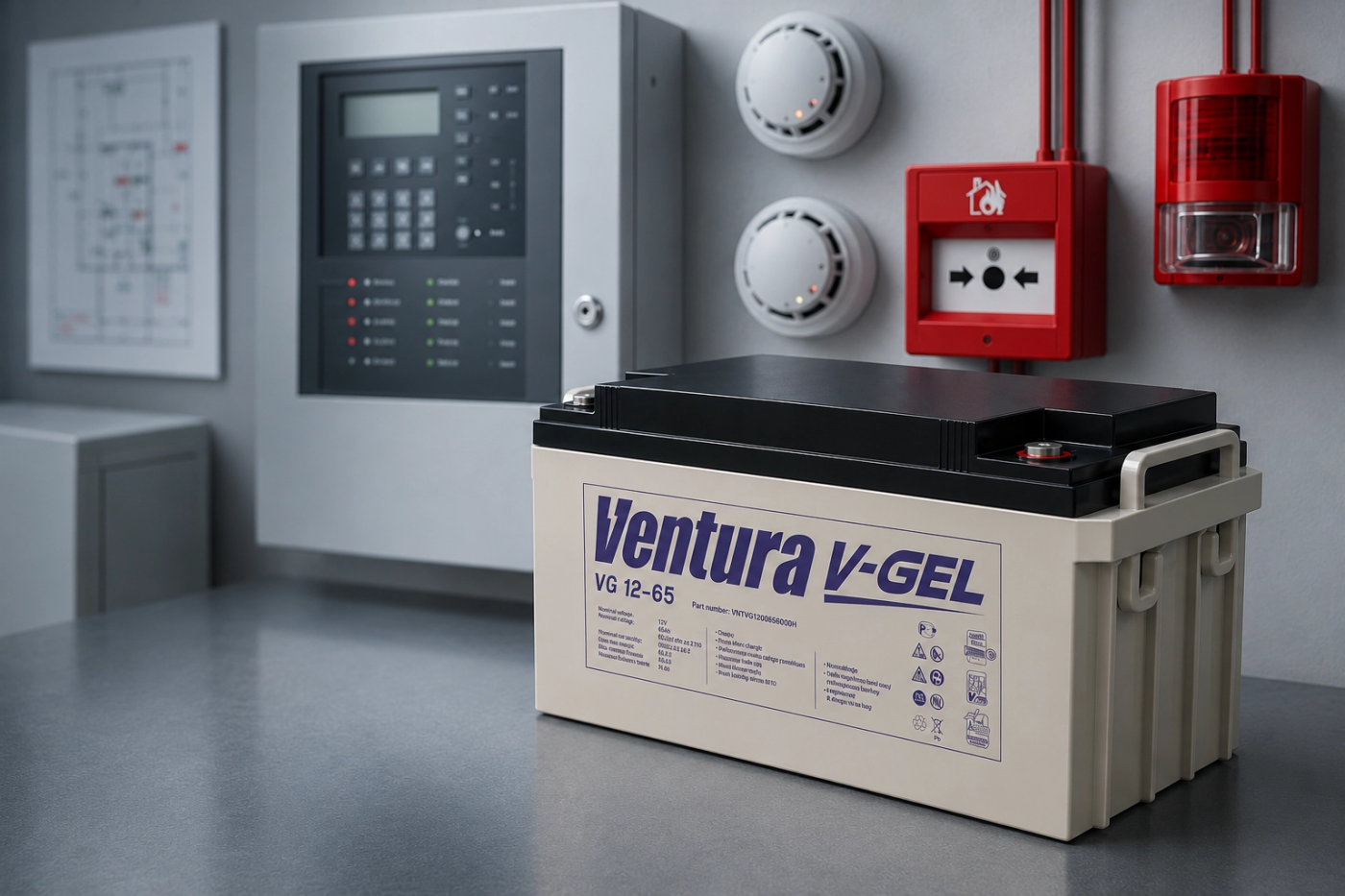
Backup power is a mandatory element of the fire alarm system (FAS). When the main power supply is turned off, it is the battery that ensures uninterrupted operation of control panels, detectors and sirens for the time established by the project and regulatory documents. Not only compliance with fire safety requirements, but also the stability of the entire complex of security and fire automatics at the facility depends on the correct selection of batteries.
Below we will look at what types of batteries are used in modern fire alarm systems, what parameters to focus on when choosing, and how to calculate the required battery capacity for a specific system.
What batteries are used in modern fire alarm systems
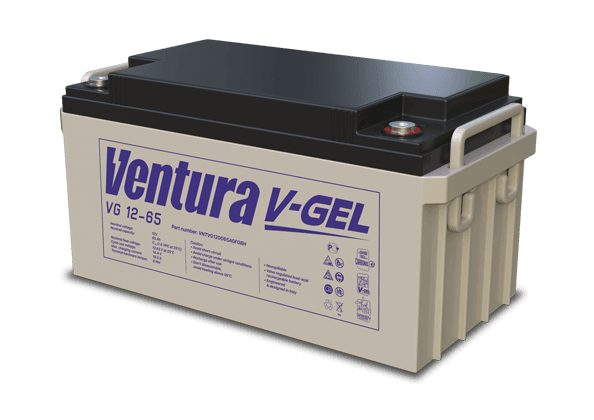
For backup power supply of fire alarms, sealed lead-acid VRLA batteries are used. The most common are AGM batteries, designed for long-term operation in float mode. GEL / V-Gel batteries can also be used if their type, charging parameters and permissible capacity meet the requirements of the power source or control panel.
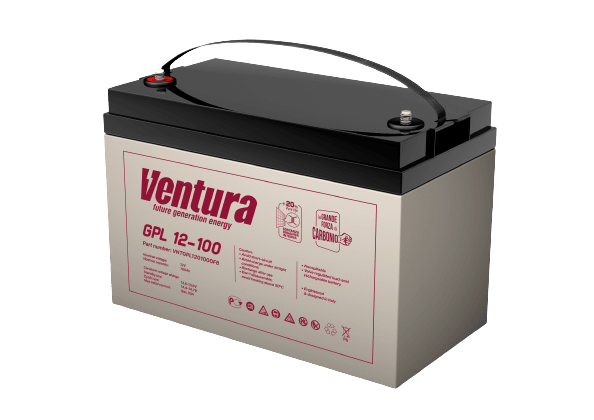
When choosing, not only the technology is taken into account, but also the charge voltage, maximum charging current, permissible capacity, dimensions, type of terminals and installation position. You cannot use a battery that is not specified in the equipment documentation, even if its voltage and capacity match.
What battery parameters for fire alarms cannot be ignored
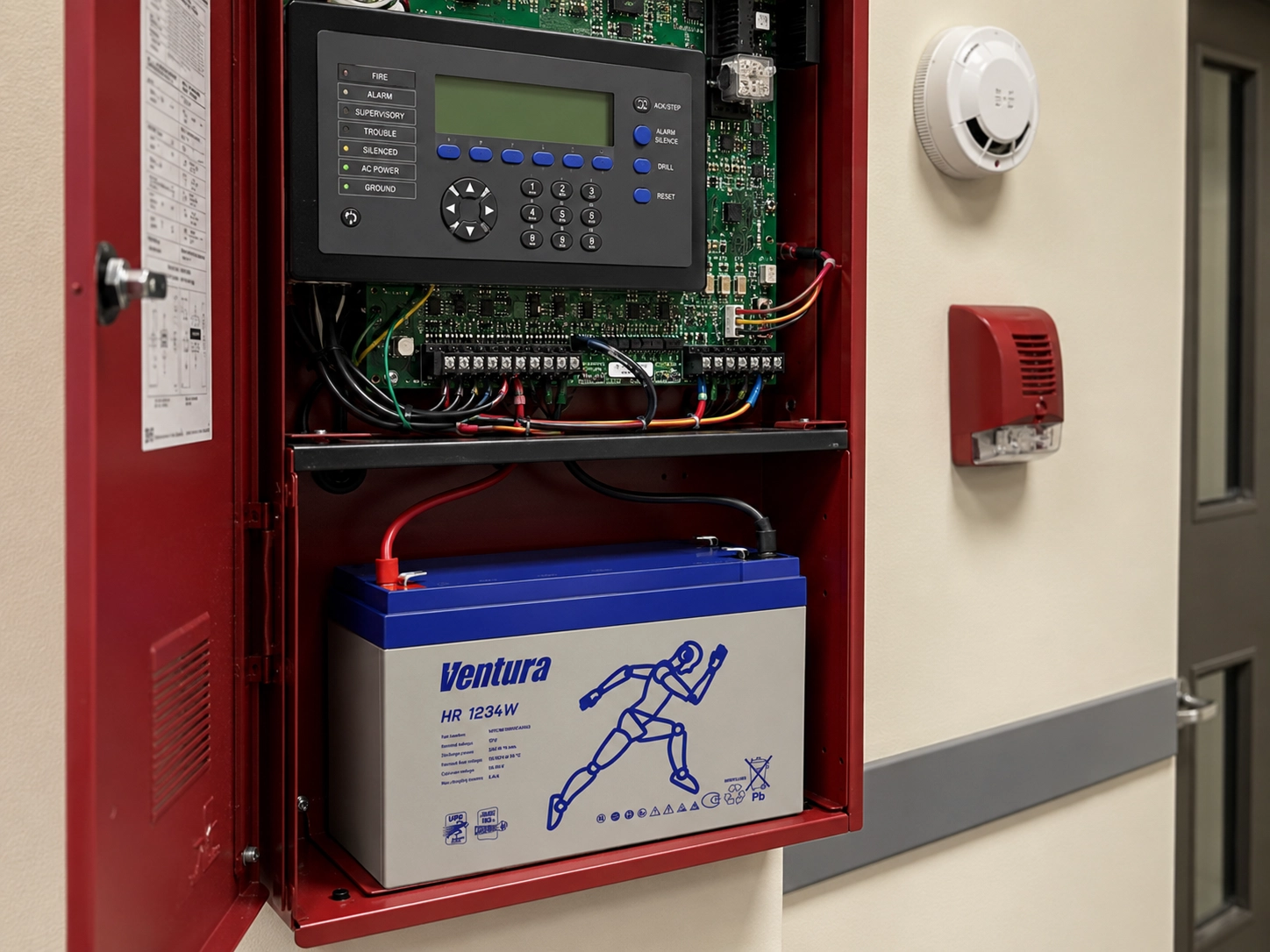
Choosing a battery for fire alarm systems is not only a matter of capacity. The reliability of the system is formed by a set of technical characteristics, each of which must correspond to the parameters of a specific control panel and operating conditions of the facility.
Battery voltage
Fire alarm systems use backup power sources of 12 and 24 V. In 24-volt sources, two identical 12 V batteries are usually installed, connected in series. The voltage, connection diagram, capacity and type of batteries must comply with the technical documentation of the specific power source or device.
Battery capacity
Capacity determines how long the system can operate autonomously when the main power supply is turned off. It is calculated based on current consumption in standby mode and “Fire” mode, taking into account the self-consumption of the power source, aging and load characteristics of the battery. The obtained value is compared with the permissible capacity of the power source, charging current and dimensions of the battery compartment.
Service Life and Cycle Life
Manufacturers indicate two interrelated indicators: service life in float mode (usually 5-12 years depending on the series) and cycle life - the number of complete charge-discharge cycles. For fire alarm systems operating primarily in a float charging mode, the service life in float mode at a nominal temperature of 20-25 °C is key.
Dimensions and compatibility with backup power supply
The battery must be placed in the instrument compartment or a separate battery box, and the type and location of the terminals must match the connecting wires. Even batteries of the same voltage and declared capacity may differ in size, weight and type of terminals, so compatibility is checked using the equipment documentation and the drawing of a specific battery model.
Temperature operating conditions
The operating temperature range of the battery must correspond to the actual placement conditions. As temperatures drop, the available capacity of a lead-acid battery decreases, and elevated temperatures accelerate aging and shorten battery life. The permissible ranges for storage, charge and discharge may vary, therefore, for unheated rooms and outdoor cabinets, temperature correction is required when calculating capacity and compliance with the manufacturer's requirements for the charging mode.
How to correctly calculate the battery capacity for a fire alarm
The calculation of the required capacity is carried out based on the total current of the equipment in two modes: standby and “Fire”. In accordance with SP 6.13130.2025, the self-consumption of the uninterruptible power supply, aging and load characteristics of the battery are also taken into account.
The calculation is performed using the formula:
C_req = k_age × k_load × [I_standby × t_standby + I_alarm × t_alarm + I_supply × (t_standby + t_alarm)],
where:
C_req – required battery capacity, Ah;
I_standby – total equipment current in standby mode, A;
t_standby – operating time in standby mode, 24 hours;
I_alarm – total equipment current in the “Fire” mode, A;
t_alarm – operating time in “Fire” mode, 1 hour;
I_supply – own current consumption of the power supply from the battery, A;
k_age – battery aging coefficient;
k_load – coefficient taking into account the load characteristics of the battery.
The coefficients and the source’s own current are determined from the technical documentation of the equipment and battery.
Calculation example. The total equipment current is 0.5 A in standby mode and 2 A in the “Fire” mode, the source’s own current is 0.05 A. For example, let’s take an aging factor of 1.25 and a load factor of 1.1:
C_req = 1.25 × 1.1 × [0.5 × 24 + 2 × 1 + 0.05 × (24 + 1)] ≈ 21 Ah.
After calculation, select a battery with a capacity not lower than the obtained value. Additionally, the permissible capacity and charging current of the power source, the dimensions of the battery compartment, the operating temperature and the discharge characteristics of the battery are checked.
How to choose a fire alarm battery that suits your system
The selection of a battery begins with an analysis of the technical documentation of the control panel: the manufacturer indicates the permissible voltage range, capacities and supported battery sizes for a specific model. Based on this data, a list of compatible battery series is generated.
Next, the temperature conditions of the room, service conditions and the required runtime are taken into account. The required capacity reserve is determined by calculation taking into account the aging of the battery and operating conditions. Since the fire alarm battery typically operates in a float mode, the main criteria are compatibility with the power source, design life, retention of required capacity, and serviceability of the battery monitoring system.
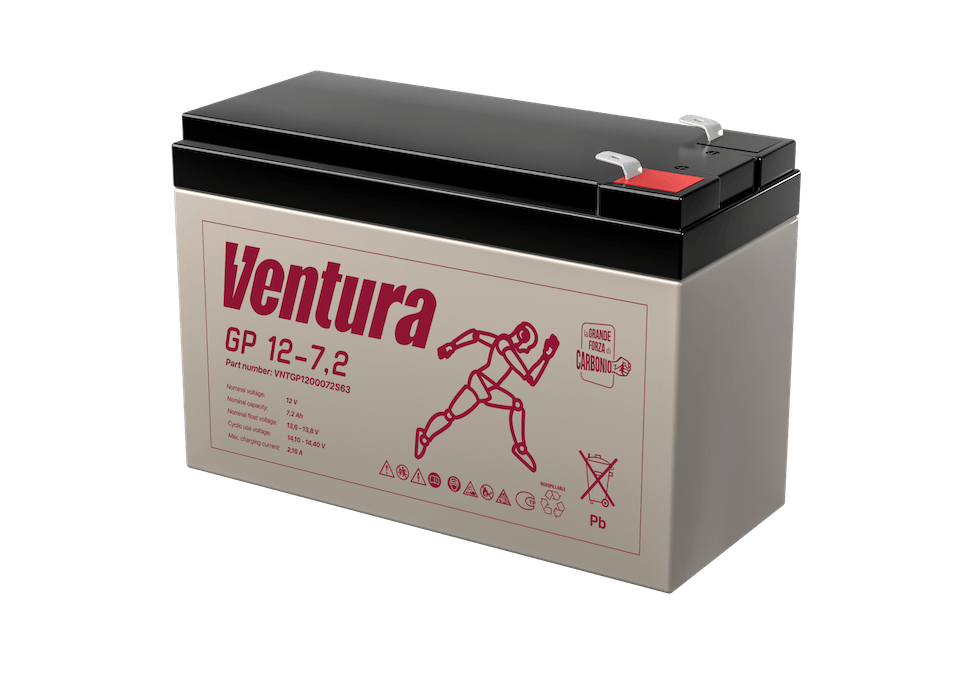
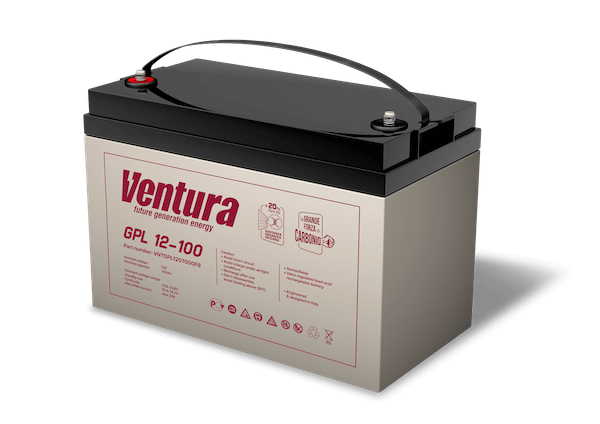
For backup power supply of fire alarms in the Ventura line, you can consider stationary AGM batteriesVentura GP andVentura GPL. Gel Ventura V-Gel batteries are used only with confirmed compatibility with the charger. The specific series and model are selected according to the requirements of the control panel or redundant power source.
Consultation with a specialist at the design stage helps to check the calculation of capacity, compatibility of the battery with the power source and compliance of the chosen solution with the technical documentation of the equipment.
Conclusion: how to choose a reliable battery for a fire alarm
The competent choice of a battery for a fire alarm is based on the consistent consideration of several factors: compliance of the voltage and size with the requirements of a particular device, accurate calculation of the required capacity for a specified runtime, as well as the selection of technology (AGM or GEL) based on the operating conditions and operating mode of the system. This approach ensures predictable and stable operation of the equipment throughout the entire declared battery life.
When designing, installing and servicing fire alarms, the current editions of SP 484.1311500.2020, SP 6.13130.2025, GOST R 53325-2012 and GOST R 59638-2021 are taken into account, as well as the technical documentation of the devices and power supplies used. The battery must meet the equipment requirements for technology, voltage, capacity, charging mode and operating conditions.
Frequently asked questions
When is it necessary to change the battery in a fire alarm?
The battery is replaced when the service life specified by the manufacturer is reached, a malfunction is detected, or the actual capacity decreases below the value required for the required backup duration. The condition of the battery is monitored as part of maintenance, taking into account diagnostic results, operating temperature and power source messages about battery failure.
What battery capacity is needed for a fire alarm?
The required capacity is determined by the total current of the equipment in standby mode and “Fire” mode. According to SP 6.13130.2025, 24 hours of operation in standby mode and 1 hour in “Fire” mode are accepted. The calculation also takes into account the power supply's own consumption, the aging factor and the load characteristics of the battery. The obtained value is checked against the technical documentation of the power source and the selected battery.
Can a car battery be used for a fire alarm?
Car starter batteries are not suitable for fire alarm systems: they are designed to deliver high inrush current for short periods of time, rather than long-term operation in float mode. For backup power supply of the fire alarm systems, sealed lead-acid batteries are used, the type and parameters of which correspond to the technical documentation of the power source.
Which is better for a fire alarm - AGM or GEL battery?
For fire alarms, AGM batteries designed for float mode are often used. A GEL or V-Gel battery can only be installed if its use is permitted by the power supply documentation and the charging parameters comply with the battery requirements. Selection prioritizes compatibility, estimated runtime, and float service life rather than just cycle life
GP (General Purpose)
Learn more
GP
GPL (General Purpose Longlife)
Learn more
GPL
VG (Gel Viscoso)
Learn more
VG