How to Choose a Forklift Battery and Keep Your Warehouse Running


 2 min read
A traction battery is a necessary condition for the operation of an electric forklift, reach truck, stacker, or hydraulic trolley. The parameters of the battery determine how long the equipment will be able to work on one charge, how often maintenance will be required, whether the battery will fit into the standard compartment and whether the calculated stability of the machine will be maintained when working with a load. You should take into account: battery type, voltage, capacity, dimensions, weight, permissible discharge depth and compatibility with the charger.
What is a traction battery for a forklift
Traction battery is a battery designed to power the electric motor, hydraulics and control electronics of warehouse equipment during the operating cycle. Unlike starter batteries, traction batteries are designed for deep charge-discharge cycles, long-term current delivery and allow equipment to operate for several hours without recharging - provided that the capacity is correctly selected for the actual load.
Structurally, the traction battery is made in the form of a monoblock or metal battery box with batteries connected in series or series-parallel. The battery's weight is factored into the truck's stability calculations and, on counterbalanced models, actually works as part of the counterweight system. That is why replacing a battery requires strict compliance not only with electrical, but also with weight and size parameters.
What batteries are used in forklifts
Basically, for electric forklifts, reach trucks, and stackers, traction batteries with liquid electrolyte or thickened electrolyte in the form of a metal battery box are used
Lead-acid batteries (FLA, Flooded Lead Acid, WET)
FLA technology (Flooded Lead Acid, also referred to as WET) remains the most common technology in traction applications due to its combination of high capacity, proven reliability and affordable cost. In such batteries, the plates are immersed in a liquid electrolyte (an aqueous solution of sulfuric acid), which ensures effective heat exchange under intense loads and high discharge currents.
Within the FLA series, there are two design types: FFT (Flat Plate Technology - flat pasted plates) and FTT (Tubular Plate Technology - tubular plates). Both designs are part of the same technological group, but differ in terms of service life and scope of application. FFT batteries with flat plates are optimal for modes with a moderate depth of discharge and standard shift patterns. FTT batteries with tubular plates provide a significantly longer cycle life - up to 1500 cycles and above - and are recommended for intensive use in two to three shifts. The tubular design better resists shedding of the active mass and maintains stable characteristics throughout its service life.
FLA lead-acid batteries require periodic maintenance: monitoring the electrolyte level, its density and topping up with distilled water. This must be taken into account when organizing the charging infrastructure in the warehouse.
Gel batteries (GEL)
Gel batteries belong to the VRLA (valve-regulated) class: the electrolyte is immobilized in a silica gel, which eliminates the need for maintenance and ensures operation in any spatial position. Gel batteries operate stably under deep discharge cycles, demonstrate uniform current output and withstand a wide range of temperatures, including operation in refrigerated warehouses.
The absence of liquid electrolyte makes gel batteries preferable for enclosed spaces with limited ventilation. They do not require special charging areas with hoods, which greatly simplifies the organization of charging in small warehouses.
Lithium-ion batteries (Li-ion, LiFePO₄)
Lithium-ion batteries with LiFePO₄ (lithium iron phosphate) technology are gaining popularity in warehouse equipment due to their high energy density, fast recharging and minimal maintenance requirements. Lithium-based batteries allow intermediate recharging without a “memory effect”, withstand deep discharges without loss of service life and provide a stable voltage throughout almost the entire discharge cycle.
Lithium-ion solutions are especially effective in multi-shift applications: one battery can cover multiple shifts with short recharges during breaks. The service life of such batteries is from 2000 to 4000 cycles, which can significantly reduce the cost of ownership in the long term. The key condition is compatibility with smart charging equipment and the presence of a BMS (battery management system).
Comparison of battery technologies for forklifts
|
Parameter |
FLA (WET) |
GEL |
Li-ion (LiFePO₄) |
|
Cycle life |
800–1500+ |
500–1000 |
2000–4000 |
|
Maintenance |
Required |
Not required |
Not required |
|
Fast charging |
No |
Partially |
Yes |
|
Working in the cold |
Satisfactory |
Good |
Good |
|
Discharge depth |
up to 80% |
up to 80% |
up to 100% |
|
Initial cost |
Low |
Medium |
High |
|
Cost of ownership |
Medium |
Medium |
Low |
Main characteristics when choosing a battery for a forklift
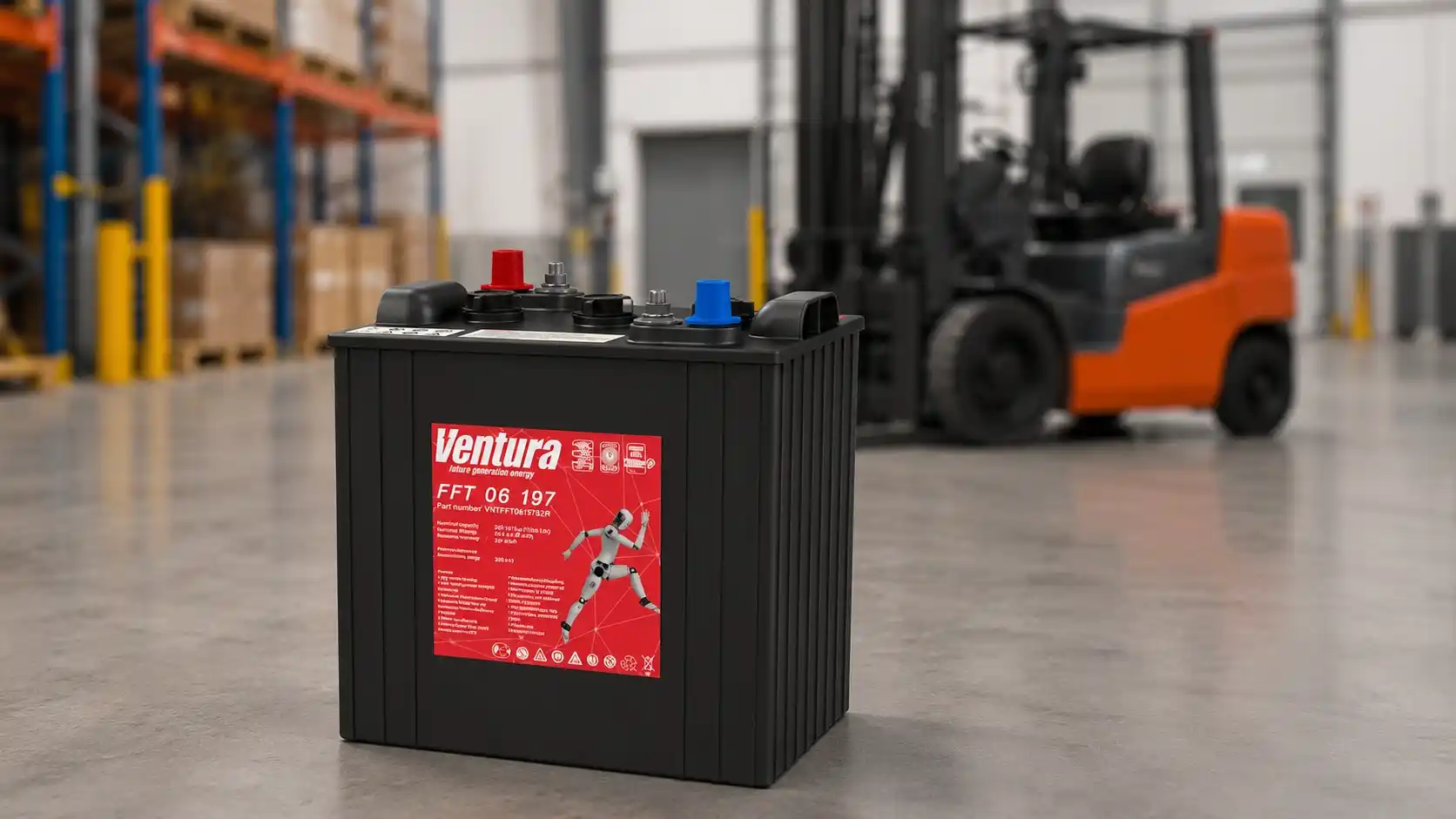
The selection of a traction battery begins with studying the technical specifications of a particular machine: voltage, permissible capacity, dimensions of the battery compartment, weight of the standard battery and type of connector. Voltage, capacity, dimensions, weight and cycle life - each of these parameters affects the compatibility of the battery with the forklift, the operating time of the equipment on one charge and the cost of operation. An error in one parameter can lead to a simple problem: the battery will not fit into the compartment, will not connect to the standard connector, will be too light for safe operation, or will not provide the required runtime.
Battery voltage
The battery voltage must strictly correspond to the rated supply voltage of the electric motor and power electronics of the forklift. Standard values for warehouse equipment are 24, 36, 48, 72 and 80 V. Voltage mismatch is unacceptable: this is a fundamental parameter that is determined by the equipment manufacturer and recorded in the machine’s technical documentation.
Battery capacity (Ah)
Battery capacity, expressed in ampere-hours (Ah), shows the remaining charge of the battery and affects the operating time of the forklift without recharging. Its calculation is carried out based on the engine power consumption, work intensity and shift duration. Basic formula for calculation:
capacity (Ah) = (Power (W) × Operating time (h)) / (Voltage (V) × efficiency × Allowable depth of discharge).
Dimensions and battery location
Each forklift has a standardized battery compartment with fixed mounting dimensions. The length, width and height of the battery must comply with DIN 43535 or another standard prescribed by the manufacturer of the equipment. When replacing, it is important to check not only the electrical characteristics, but also the exact dimensions, type and location of the terminal pins.
Battery weight and impact on forklift stability
The traction battery for a forklift is an important element of the counterweight system. Its weight is calculated by the equipment manufacturer in accordance with the maximum load capacity of the machine. Replacing the battery with a lighter model (for example, switching to lithium-ion) may require the installation of additional ballast weight - this issue must be agreed with the manufacturer or a certified service center.
Number of charge-discharge cycles
Cycle life is a key indicator of battery economic efficiency. It is specified by the manufacturer at a standard depth of discharge (typically 80%) and a temperature of 25 °C according to IEC 60254-1. The higher the shift and intensity of work of the forklift, the more important it is to choose a battery with maximum cycle life.
Allowable discharge depth
It is recommended to discharge lead-acid batteries to no more than 80% of their rated capacity. LiFePO₄-based lithium-ion batteries can be discharged up to 90–95% without significantly reducing their service life. Maintaining the recommended discharge depth has a direct impact on battery life and the number of operating cycles available.
How to choose battery voltage for a forklift
The voltage is determined by the class of equipment and its load capacity:
-
24 V batteries – pallet trolleys, light stackers up to 1.5 tons, horizontal conveyors. The best option for light warehouse equipment.
-
36 V batteries – stackers with a lifting capacity of 1.0–2.0 tons, entry-level reach trucks, order pickers. Provide a balance of power and backup duration for medium loads.
-
48 V batteries are the most common voltage for forklifts with a lifting capacity of 1.5–3.5 tons. The optimal combination of power, efficiency and availability of charging equipment.
-
72 V batteries – heavy forklifts with a lifting capacity of 3.5–5.0 tons. Used for high demands on traction and productivity.
-
80 V batteries – heavy warehouse equipment and specialized forklifts with a lifting capacity of over 5.0 tons, operating under peak load conditions. Provide maximum engine power and stable current under intense loads.
How to determine the required battery capacity for a forklift
The battery capacity is calculated based on several initial parameters: load current consumption (A), work shift duration (hours), number of shifts without full charging, permissible discharge depth and operating temperature.
Practical formula for accurate calculation:
Capacity (Ah) = (Load current × Operating time) / Allowable depth of discharge
For example, a forklift with a consumption of 150 A during a 6-hour shift and an allowable discharge of 80% will require a battery with a capacity of at least: (150 × 6) / 0.8 = 1125 Ah at operating voltage.
How operating mode affects the choice of battery
The operating mode of the forklift is a key criterion when choosing the battery type. For one eight-hour shift per day, FLA or GEL lead-acid batteries are sufficient: overnight they fully restore the charge, and the load on the battery remains within acceptable limits.
In a two- and three-shift warehouse operation, the battery does not have time to complete a full charging cycle between shifts. Here, the choice in favor of lithium-ion batteries with fast charging support is justified: during a 30-60 minute break between shifts, the battery restores a sufficient charge level to continue working. This helps reduce downtime and, in some scenarios, allows operation without a replaceable set of batteries, if the charging infrastructure is designed for this mode.
How to choose a battery according to the type of forklift
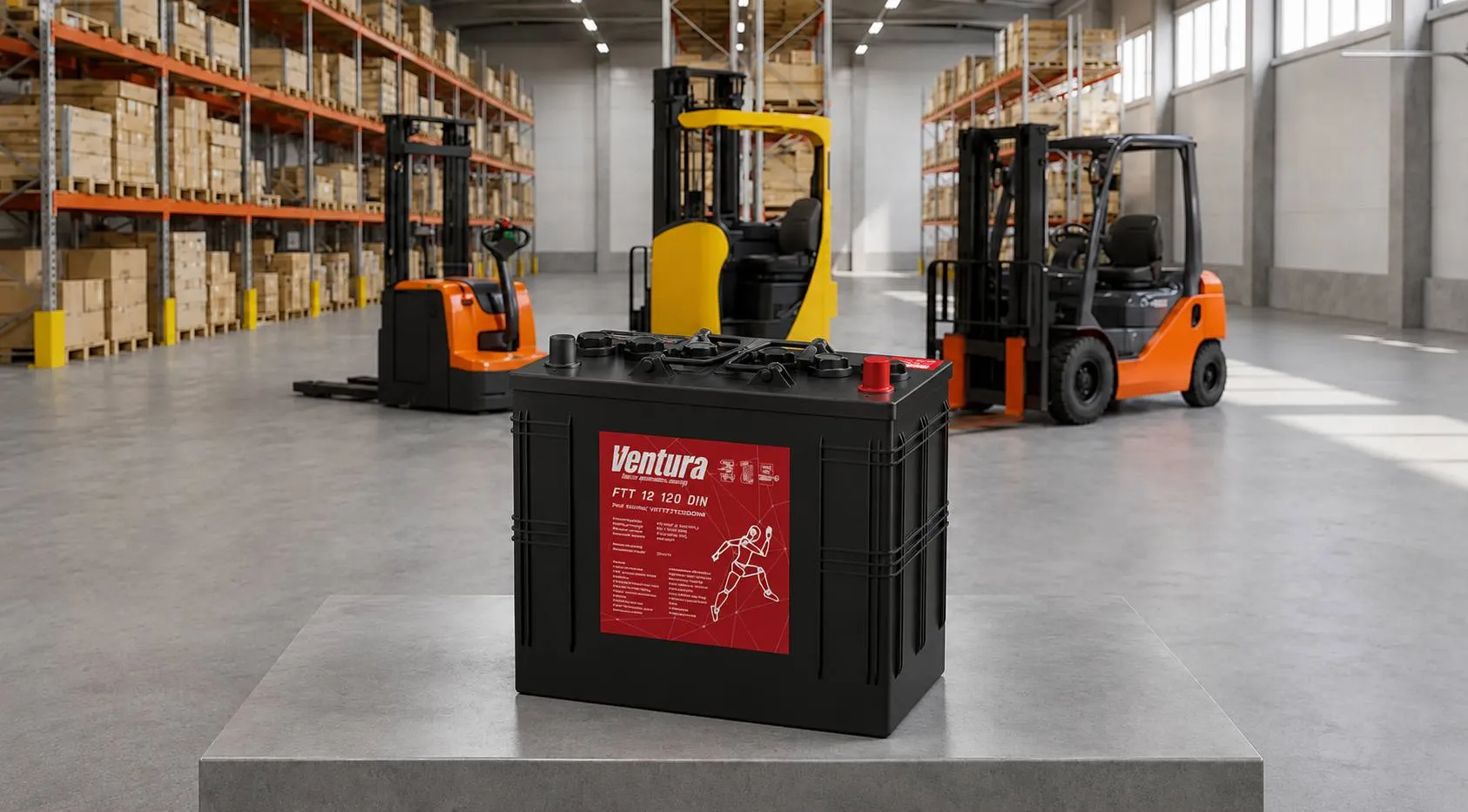
Different types of warehouse equipment require traction batteries with certain parameters (supply voltage, capacity, permissible dimensions), which are selected taking into account the load profile. Forklift, reach truck, stacker and pallet truck - each machine has its own operating mode, engine power and design limitations of the battery compartment. Understanding these differences allows you to immediately narrow down the choice to suitable technical solutions and avoid a situation where the battery is formally suitable in voltage, but does not provide the required backup duration or does not fit into its mounting compartment.
Electric forklifts
Forklifts are the most energy-intensive category of warehouse equipment. Typical parameters of the traction battery: 48 V or 80 V, capacity 400–1000 Ah, weight 800–1500 kg. The battery performs dual functions as a power source and a ballast counterweight. For intensive applications, FTT batteries or lithium-ion solutions are recommended.
Reach trucks
Reach trucks operate in narrow aisles of high-rise warehouses and place increased demands on precision control. Standard voltage – 48 V, capacity 400–750 Ah. Stable voltage throughout the discharge cycle is critical for accurate mast positioning.
Stackers
Electric stackers are used to lift and transport goods to heights. Power supply – 24 or 48 V, capacity 150–500 Ah. Gel batteries are especially convenient here: they do not require ventilated charging areas and are suitable for indoor storage areas.
Electric trolleys and pallet carriers
Horizontal pallet carts are the most popular class of equipment. Voltage 24 V, capacity 100–300 Ah. Simple operation mode allows you to use budget lead-acid batteries or switch to GEL to reduce maintenance costs.
Order pickers
Pickers are characterized by high cycle life of short trips and climbs - this creates a specific load profile with frequent peak currents. Lithium-ion batteries demonstrate the best performance here: stable voltage, fast intermediate charging and no loss of capacity with frequent partial cycles.
Review of Ventura traction batteries for forklifts
Ventura Battery offers a complete line of traction batteries for forklifts, reach trucks, stackers, hydraulic trolleys and order pickers. Solutions cover the voltage range 24–80 V and capacities from 100 to 1500 Ah, including classic lead-acid batteries of the FFT and FTT series.
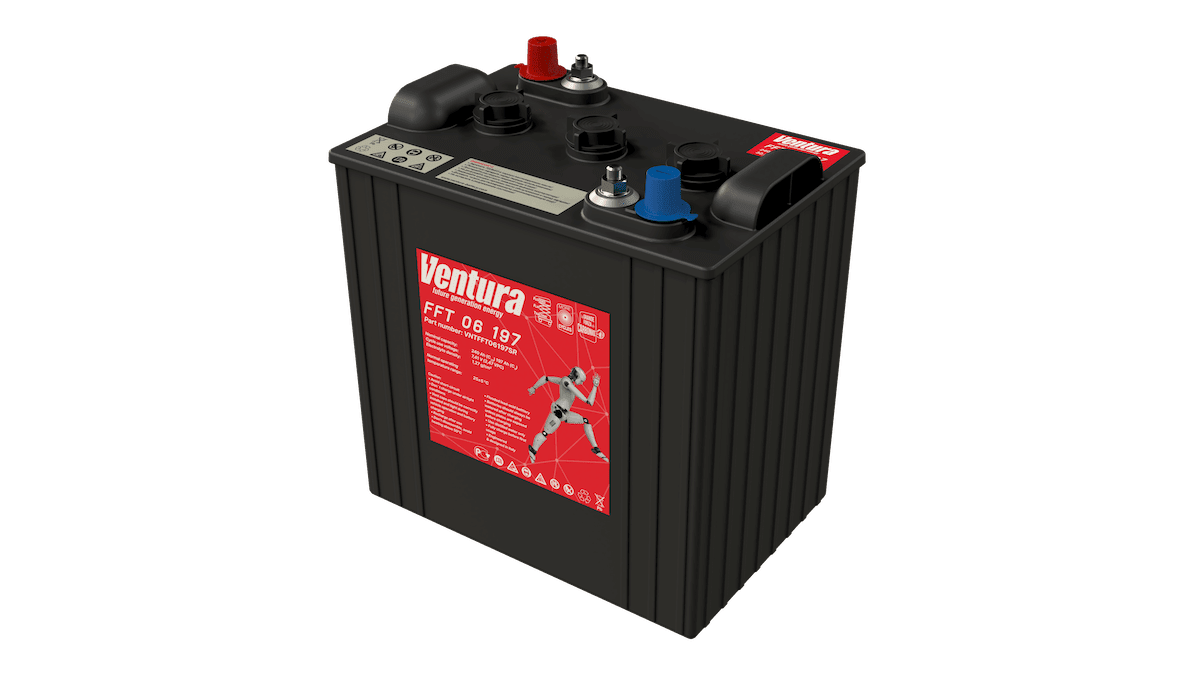
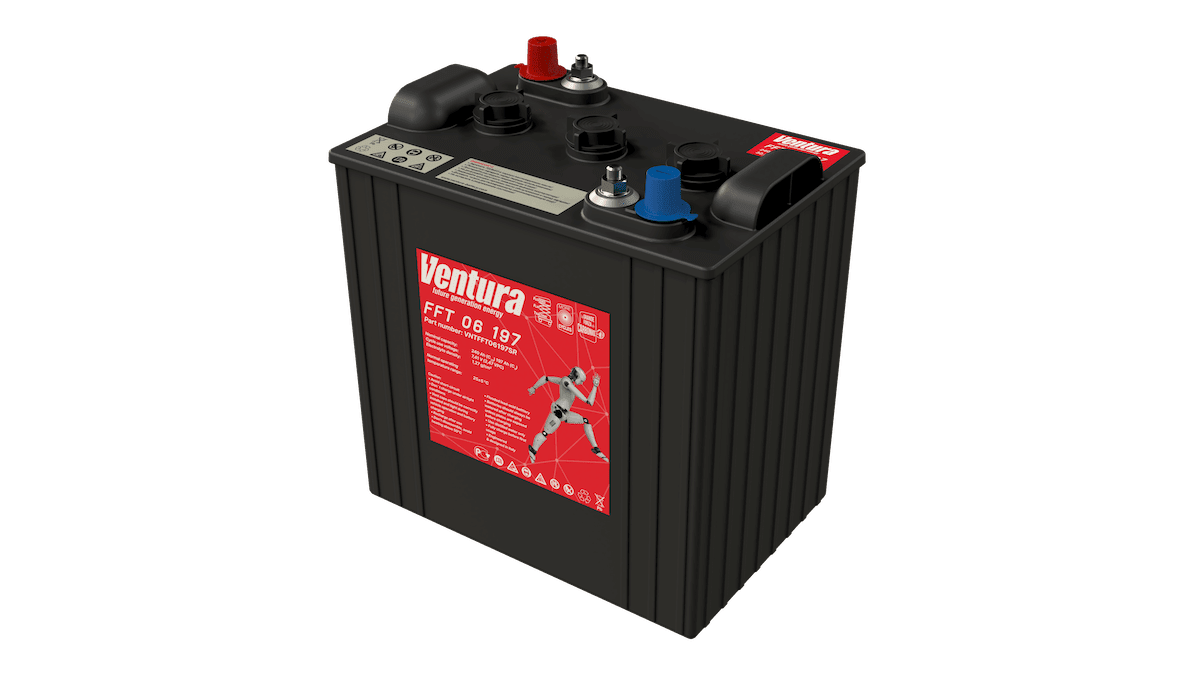
SeriesVentura FFT - lead-acid traction batteries with pasted grid plates for standard operating modes. Optimal for single-shift work, they are distinguished by an affordable price and a long service life if the recommended charging modes are observed.
All Ventura batteries are manufactured in accordance with the requirements of IEC 60254-1 (traction lead-acid batteries) and are accompanied by a complete set of technical documentation. The company provides support in selecting batteries, coordinating with charging equipment and organizing delivery.
Checklist for choosing a battery for a forklift
Please check the following parameters before submitting your application:
-
Forklift Rated Operating Voltage (24/36/48/72/80-96V)
-
forklift model, manufacturer and lifting capacity
-
Battery compartment dimensions (DIN size or equipment manufacturer data)
-
Minimum required mass of standard battery (to maintain stability)
-
Shift and operating mode (1, 2 or 3 shifts)
-
Required runtime on one charge
-
Availability of quick recharging between shifts
-
Operating conditions: temperature, humidity, type of warehouse
-
Type and characteristics of the available charger
-
Maintenance preferences: battery type: maintenance-free or with electrolyte control
Conclusion
A suitable battery for a forklift is a battery that matches the equipment in terms of voltage, dimensions, design features, weight, capacity and charging mode. This selection reduces the risk of downtime and makes operating costs more predictable. The choice between lead-acid, gel and lithium-ion batteries depends on the type of equipment, operating mode, charging infrastructure and economic priorities of the enterprise.
Frequently asked questions
Which battery is best for a forklift?
The choice is determined by the operating mode. For one shift, lead-acid batteries of the FTT series with tubular plates are optimal - high cycle life at a moderate cost. For two- or three-shift operation, lithium-ion batteries with fast charging support are preferable.
Can a lead-acid battery be replaced with a lithium battery?
Technically yes, provided the voltage is correct, the charger is compatible with lithium-ion technology and the battery has a BMS. It is also necessary to take into account the change in weight and, if necessary, adjust the ballast of the forklift.
Which is better for a forklift - a lithium or lead-acid battery?
Lithium-ion batteries usually win in terms of charging speed and ease of operation in multiple shifts, but the economics must be calculated based on the specific operating mode. Lead-acid batteries are preferred when purchasing budgets are limited, charging infrastructure is available, and the equipment operates a standard single shift.
How long does a traction battery last for a forklift?
The service life of FTT type lead-acid batteries is 5–7 years or 1200–1500 cycles, subject to proper charging and maintenance regulations. Lithium-ion batteries last 8–12 years and can withstand 2,000 to 4,000 cycles.
How often should the forklift battery be charged?
Lead-acid batteries require a full charging cycle after each shift - it is not recommended to interrupt or delay charging. Lithium-ion batteries allow intermediate recharging at any time without reducing service life.
Is the lithium battery suitable for multi-shift work?
Yes, this is one of the key advantages of lithium-ion batteries. Intermediate recharging during a 30–60 minute break allows you to use one battery in two or three shifts without replacing or reducing battery life.
Is it possible to install a larger capacity battery on an electric forklift?
As long as standard dimensions and weight are maintained, as a rule, yes. This allows you to increase backup duration without changing the design. Exceeding the permissible weight or non-standard dimensions requires approval from the equipment manufacturer.
Which battery is best for working in refrigerated warehouses?
GEL gel batteries maintain satisfactory capacity at temperatures down to −15 °C and do not require maintenance in a closed refrigerated warehouse. LiFePO₄ lithium-ion batteries are also effective at lower temperatures, especially when equipped with a built-in heating system (controlled by a BMS). Traction batteries with a leaded copper negative plate are also recommended
How to choose a charger for a traction battery?
The charger is selected based on the battery voltage and recommended charging current (usually C/5–C/8 for lead-acid batteries) and charging profile. For lithium-ion batteries that charge at higher currents, a compatible charge controller that supports the appropriate profile is required. Your Ventura Battery dealer's technical support staff can help you select compatible charging equipment.
How to determine the required battery capacity for a forklift?
The capacity is calculated based on the motor current consumption, shift duration and permissible discharge depth. For an accurate calculation, contact the technical support specialists of the Ventura Battery distributor: they will make a selection taking into account the actual load profile of your forklift and the operating conditions of the warehouse.