How Long Will a Battery Last? Calculating Battery Runtime


 2 min read
Accurate calculation of battery runtime is an important task on which the reliability and profitability of an object directly depends. For a data center, bank, communications center or warehouse with electric forklifts, an error in calculating backup duration results in either excessive costs for batteries that will never be needed in full, or the risk of not being able to last until the main power is restored. Let's look at what the operating time of a battery is made up of, what formulas an engineer and designer should use, and how to select a battery for a specific task - from UPS backup to traction applications on warehouse equipment.
What determines battery runtime
Battery runtime is not a fixed number from a data sheet, but the result of the interaction of several parameters: battery capacity, nature of the load, equipment efficiency and operating conditions. The manufacturer indicates nominal values under standard conditions (usually 20-25 °C, a certain discharge current), and the actual operating time is always calculated for a specific task.
That is why engineers calculate backup duration for each object separately - taking into account the type of load, room temperature and discharge depth permissible for a specific battery technology.

Battery capacity and voltage
Capacity in ampere-hours shows the reserve of electrical charge measured at a given discharge mode. For example, for the Ventura GP 12-100, the 100 Ah rating is specified at a 20-hour discharge to 1.75 V per cell. At other currents, the available capacity is determined from the manufacturer's discharge tables or taking into account the Peukert effect.
The voltage of the battery or battery assembly (12 V, 24 V, 48 V and higher for industrial stationary and traction systems) together with the capacity determines the total energy supply in watt-hours. The higher the system voltage for the same amp-hour capacity, the more energy is available to the load - this is especially important when designing battery packs for data centers and telecommunications facilities, where batteries are often assembled in strings of 24 V, 48 V or 110-220 V.
Power and current consumption of equipment
The second key parameter is the power consumed by the connected equipment. For server equipment, communication racks or medical equipment, active power is usually measured in watts; for traction applications (electric forklifts, stackers, reach trucks) it is more common to operate with an average discharge current in amperes, since the load on the drive motor changes during the shift.
When lifting a load, the current and power may increase briefly. To assess backup duration, average power over a representative operating cycle is used, and the battery, controller, cables and drive are separately tested for peak power and current.
Unlike DC networks, in AC networks the power consumption (so-called active power), measured in watts, is not necessarily equal to the effective current times the effective voltage. If there is a phase shift between current and voltage (which is typical, for example, for electric motors and transformers), the active power is less than the specified product. In order to describe this effect, the concepts of apparent power, active power and reactive power are introduced in technology. To select the rating of circuit breakers, electrical sockets, electrical wiring cross-section, etc. the relevant quantity is apparent power, measured in kVA, kilovolt-amperes
If you are interested in active power in kW, then it can be calculated using the formula P=S·cosφ Typically, cos φ values in our case take from 0.8 to 0.84.
System efficiency and permissible depth of discharge
Between the battery and the load there may be conversion equipment - an inverter, a DC/DC converter or a traction controller. These nodes, as well as cables and connections, introduce losses, so their total efficiency is taken into account in the calculation. The charger is not included in the discharge circuit and does not directly affect the battery runtime.
The second parameter is the permissible depth of discharge (DoD, Depth of Discharge). Its value is selected according to the documentation of the specific battery and operating mode. In cyclic mode, reducing the discharge depth usually increases the service life, and in backup power systems the calculation is often carried out to a given final discharge voltage. Therefore, the useful capacity cannot be determined by the same coefficient of 70–80% for all AGM and GEL batteries.
How to quickly calculate battery runtime
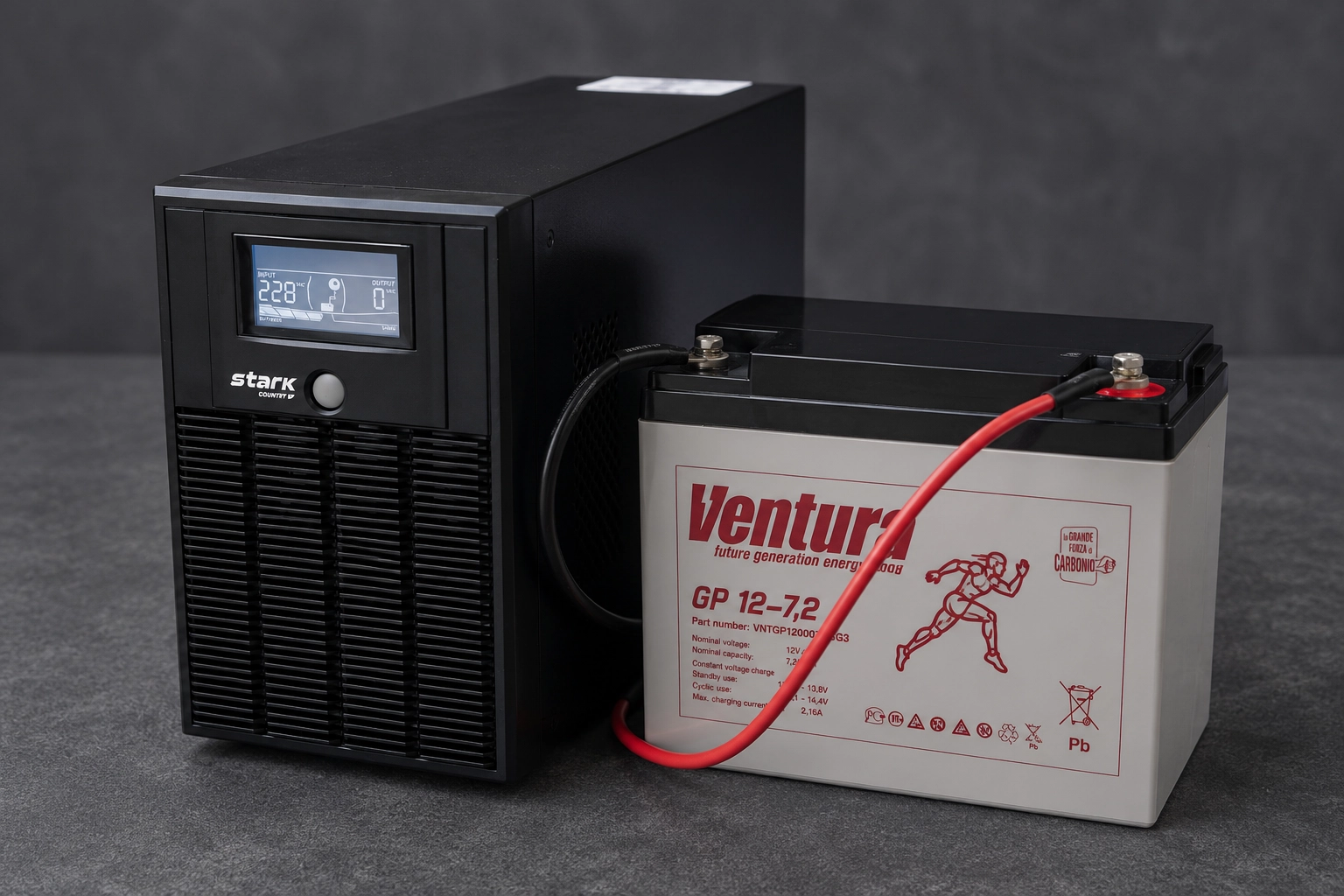
There are two basic approaches to calculation - through the load current in amperes and through the load power in watts. The choice depends on what data is at hand: the technical data sheet of the equipment usually indicates either current consumption or active power.
Calculation of battery operating time based on current consumption
For a preliminary assessment at direct current measured directly at the battery terminals, use the formula:
Operating time (h) ≈ (Battery capacity, Ah × DoD) / Battery current, A
This calculation does not take into account the change in available capacity at different discharge currents, so the result must be clarified using the manufacturer’s discharge table.
Example for stationary application: Ventura GP 12-100 battery (12 V, 100 Ah) powers a load at which the current directly at the battery terminals is 8 A, with a calculated depth of discharge of 80%:
Time ≈ (100 × 0.8) / 8 = 10 hours.
Example for a traction application: A 48V 400Ah traction battery powers an electric forklift that draws an average of 60A directly from the battery, with a design depth of discharge of 80%:
Time ≈ (400 × 0.8) / 60 ≈ 5.3 hours.
Calculation of battery operating time based on load power
If the load power in watts is known, the formula is used for a preliminary assessment:
Operating time (h) ≈ (Battery capacity, Ah × Nominal voltage of battery assembly, V × DoD × converter efficiency) / Load power, W
For lead-acid batteries, the obtained result must be clarified using the manufacturer’s discharge tables at the selected final voltage.
Example for stationary use: a 24 V battery assembly with a total capacity of 150 Ah powers a communication center with a power of 900 W, DoD – 0.8, inverter efficiency – 0.9:
Time ≈ (150 × 24 × 0.8 × 0.9) / 900 ≈ 2.88 hours.
Example for traction application: warehouse equipment on a 24 V 250 Ah battery with an average load of 1800 W, DoD for cyclic mode - 0.8, efficiency - 0.87:
Time ≈ (250 × 24 × 0.8 × 0.87) / 1800 ≈ 2.3 hours.
Below is a summary table for a quick assessment for different combinations of parameters:
|
Type of application |
Voltage, V |
Capacity, Ah |
Load |
DoD |
Efficiency |
Approximate operating time |
|
Stationary (UPS/Communication) |
12 |
100 |
8 A at battery terminals |
0.8 |
– |
≈ 10 h |
|
Stationary (communication center) |
24 |
150 |
900 W |
0.8 |
0.9 |
≈ 2.9 h |
|
Traction (loader) |
48 |
400 |
60 A at battery terminals |
0.8 |
– |
≈ 5.3 h |
|
Traction (stacker) |
24 |
250 |
1800 W |
0.8 |
0.87 |
≈ 2.3 h |
How to convert battery capacity from ampere hours to watt hours
To compare batteries of different voltages, it is more convenient to operate with energy in watt-hours rather than ampere-hours. The conversion formula is simple:
Energy (Wh) = Capacity (Ah) × Voltage (V)
For example, a 12V 100Ah battery has a rated electrical output of 1200Wh, and a 48V 50Ah battery has a rated energy of 2400Wh, although its amp-hour rating is half that. Watt hours allow you to compare the rated energy reserves of batteries of different voltages, but the actual energy available depends on the current, temperature and final discharge voltage.
The Ventura GP series is well suited for stationary tasks with moderate and stable loads (for example, for UPSs, fire protection systems and server equipment): it is distinguished by predictable energy output, maintenance-free design and ease of calculating backup duration using the above formulas.
Why Actual Battery Runtime Can Differ from the Calculation
Simplified formulas give an approximate estimate under accepted initial conditions, but in practice the result is influenced by several additional factors. They must be taken into account during design so that the backup duration of the facility covers the required backup time.
Understanding these factors is part of the engineering culture when selecting industrial batteries: a competent calculation from the very beginning takes into account real operating conditions, and not just the manufacturer’s data sheets.
Operating temperature
Lead-acid batteries are sensitive to ambient temperature. When it is lowered, the available capacity decreases, and the amount of reduction depends on the battery model, discharge current, operating time and final voltage.
Size and nature of the load
The higher the discharge current relative to the nominal capacity of the battery, the less useful energy can be extracted - this is the Peukert effect, characteristic of lead-acid technologies. The impact of peak loads on backup duration depends on their amplitude, duration and frequency, so there is no universal correction of 10-20%. For a more accurate assessment, use the real load profile and the manufacturer’s published discharge characteristics for the corresponding mode.
Battery condition and service life
With calendar aging and accumulation of charge-discharge cycles, the available battery capacity gradually decreases. Ventura batteries are designed with a calculated cycle life and calendar life, which is indicated in the technical documentation, and regular monitoring of the condition of the battery fleet allows you to accurately plan the timing of scheduled battery upgrades without affecting the reliability of the backup.
Energy losses and equipment efficiency
Inverters, converters and cable runs introduce their own losses. When designing a backup power system, they are taken into account by the efficiency of specific equipment at the actual load and by the calculated losses in the cables.
How to choose a battery so that it is sure to last
The practical problem is often formulated the other way around: the power of the equipment and the required battery runtime are known, but it is necessary to determine what battery capacity to include in the project. For preliminary assessment use the formula:
Required capacity (Ah) ≈ (Load power, W × Required time, h) / (Voltage, V × DoD × efficiency)
Example: a server rack consumes 2000 W, and the required battery runtime is 4 hours with a battery pack voltage of 48 V, DoD 0.8 and efficiency 0.9:
Preliminary capacity ≈ (2000 × 4) / (48 × 0.8 × 0.9) ≈ 231 Ah.
The resulting 231 Ah is a preliminary value using a simplified formula, and not the final rating of the battery assembly. The final capacity is determined from the datasheets at a given final voltage, taking into account temperature, aging, load profile and design reserve separately. Traction technology also requires a realistic duty cycle, so average power alone is not enough.
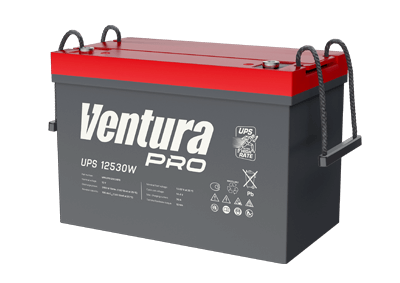
For facilities with high requirements for the quality and stability of power supply - data centers, banking infrastructure, medical institutions and communication centers - the capacity reserve is determined by calculation. Separately, they take into account the reduction in capacity at the end of the service life, the minimum operating temperature, possible increase in load, losses in connections and design reserve. For such tasks, the Ventura line includes solutions for stationary use and a series Ventura PRO with an extended service life, and for warehouse equipment, loaders and stackers - batteries for traction use.
Conclusion: how to correctly calculate battery operating time
The preliminary calculation of battery operating time is based on three operations: converting the nominal capacity into watt-hours, assessing the backup duration in terms of current or load power, and recalculating the required capacity. The method of taking into account the depth of discharge and losses depends on the chosen method: when calculating using data sheets, the available capacity is determined by the final voltage, and the efficiency is taken into account only for equipment located between the battery and the load. If the current is measured directly at the battery terminals, there is no need to additionally multiply the result by the efficiency.
The final step is to take into account the conditions of the facility: room temperature, the nature of the load and the battery service-life margin. A competent engineering approach to calculation, supported by the correct selection of technology and series of batteries - for example, the GP or Ventura PRO series using AGM technology or the gel series V-Gel - allows you to design a backup power system taking into account the required backup duration and aging of batteries. To clarify the parameters of a specific Ventura series, technical documentation is available, and the company’s specialists are ready to advise on the selection of batteries for the tasks of data centers, communications, energy, medicine, banks, security and fire systems and warehouse equipment.
Frequently asked questions
How to calculate the required battery capacity for a given operating time?
For a preliminary estimate, use the reverse calculation formula: capacity (Ah) ≈ (load power, W × required time, h) / (voltage, V × DoD × efficiency). The obtained value is clarified using the manufacturer’s discharge tables at a given final voltage, after which temperature, battery aging, possible load growth and design reserve are taken into account separately.
How does the operating time change when batteries are connected in series and in parallel?
When identical batteries are connected in series, the voltages are summed up, and the capacity of the assembly in ampere-hours remains equal to the capacity of one battery. In a parallel connection, the voltage is maintained and the ampere-hour capacities are summed up. With the same number of identical batteries, the total rated energy of the assembly does not depend on the connection method: its voltage, capacity in ampere-hours and permissible current change. The selected circuit must be approved by the battery manufacturer.
Why does the battery last less than the estimated time?
The actual time may be less than the estimated time due to high discharge current, low temperature, battery aging, equipment and cable losses, load peaks, or reaching the specified final voltage. For a more accurate assessment, use the certified discharge tables, the actual load profile and corrections for operating conditions.
How to calculate the operating time of two or more batteries?
First, determine the parameters of the battery assembly: when connecting identical batteries in parallel, add their capacities while maintaining the voltage of one battery, and when connecting in series, add the voltages while maintaining the capacity of one battery. Then perform a preliminary calculation for power or current and check the result using the published discharge characteristics. For the same assembly, use compatible batteries of the same model, capacity and similar age, and follow the manufacturer's requirements for serial and parallel connections.