Gel batteries: what they are, where they are used, and their advantages


 10 min read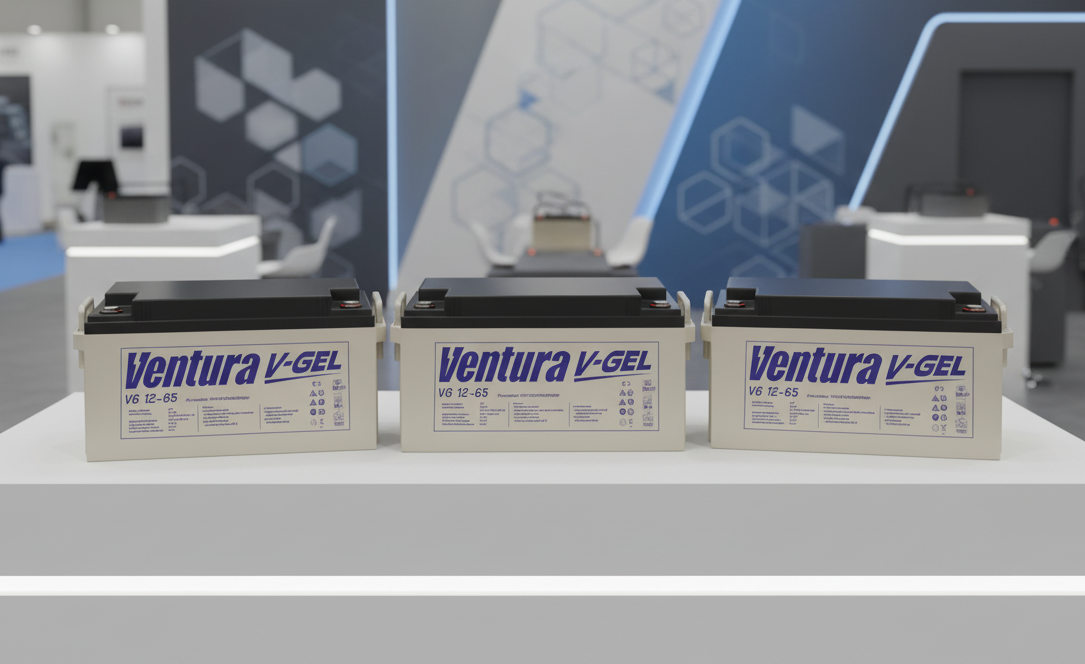
A gel battery (VRLA GEL) is a type of lead-acid battery in which the electrolyte is thickened to a gel-like state. The sealed design with valves eliminates electrolyte spillage, reduces the risk of corrosion and stratification, and increases resistance to deep discharges and temperature influences. Such batteries are used in uninterruptible power supplies and telecom cabinets, guaranteed power supply systems, solar and wind installations, medical equipment, transport and communications facilities, mobile electrical platforms and other types of floor-mounted trackless electric vehicles.
What is a gel battery and how it works
In GEL batteries, the sulfuric acid electrolyte is bound with silicon dioxide (SiO2). The space between the plates is filled with gel. When recharging, oxygen is released on the positive plate. It passes through the gel to the negative plate and there it turns back into water. This oxygen cycle keeps moisture inside the battery. This operating principle reduces gas emission and evaporation and allows the battery to be used in closed and ventilated areas.
Specifications
The main parameters that you should pay attention to in the technical data sheet and on the battery label:
- Rated voltage. Batteries are available in 2, 6 and 12V.
- Capacity and C20. Capacity is usually indicated by 20-hour discharge (C20). Example: 12V 100 Ah (C20) means that the battery delivers 100 Ah when discharged for 20 hours to the specified final voltage.
- Internal resistance (conductivity). This parameter affects the ability to deliver high power at short intervals. Gel batteries generally have higher internal resistance than lead-acid batteries. Therefore, with the same capacity, the peak power of gel batteries is lower.
- Temperature range. Typical operating conditions for a gel battery are from -15 to +50 °C (exact values are in the data sheet). Design characteristics correspond to 20-25 °C.
- Low self-discharge. When storing the battery at ~20 °C, it is recommended to recharge it every 6-9 months.
- Service life. In buffer mode (UPS/telecom, constant charge maintenance at 20-25 °C), gel batteries of the increased durability series are designed for approximately 10-12 years of operation, subject to operating conditions.
Types of gel batteries and applications
- Monoblocks 12/6 V (flat plates). Standard sealed batteries for uninterruptible power supplies, telecommunications equipment, security and fire systems and autonomous power supply of devices. They are also suitable for small solar installations.
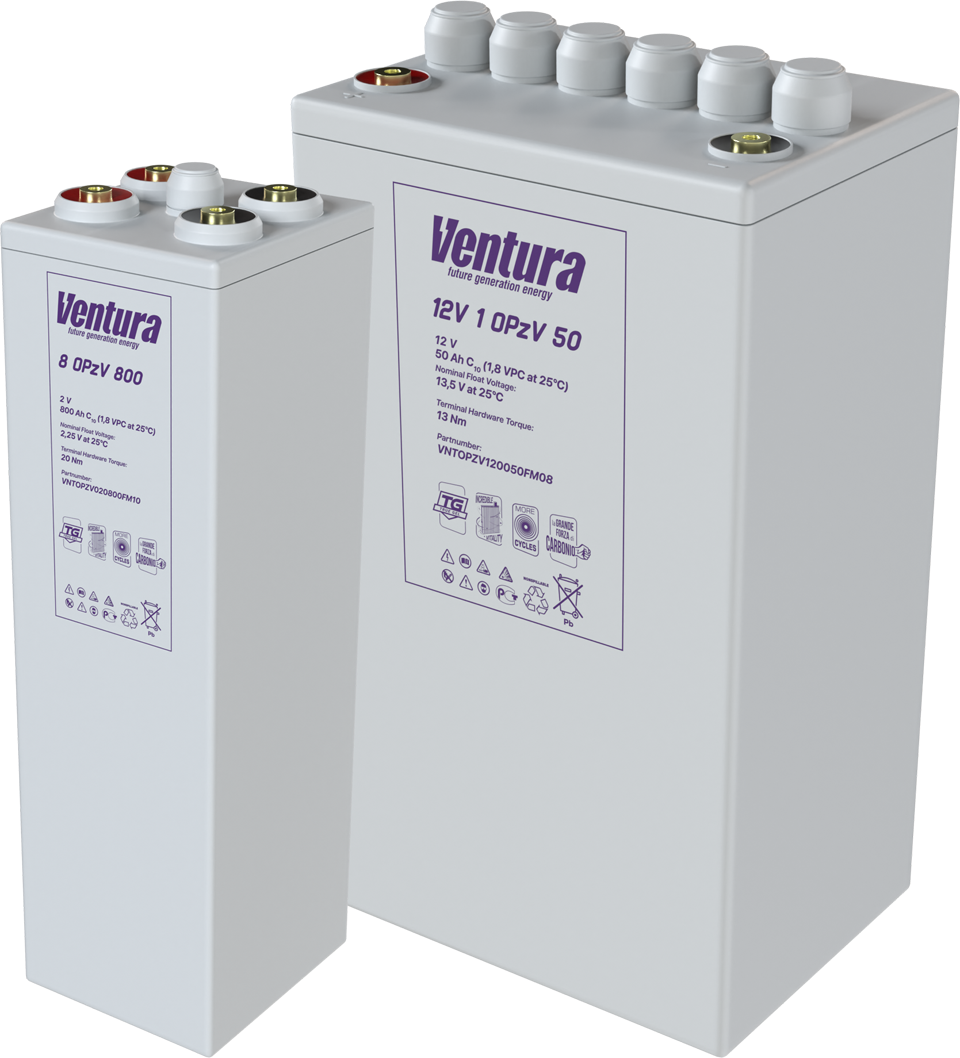
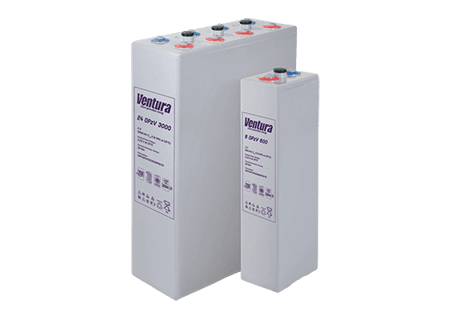
- OPzV - 2-volt models with tubular plates. They are used in stationary energy storage systems, at telecom nodes and industrial facilities, where long service life and deep discharge operation are important.
- Traction gel batteries. Designed for regular charge-discharge cycles in mobile equipment (scrubber dryers, trolleys, lifts, etc.) at moderate currents.
- Gel batteries with front terminals. The terminals are located on the front panel, which simplifies installation and maintenance in cabinets.
Pros and cons of gel batteries compared to lead acid batteries
Gel batteries tolerate deep discharges and elevated temperatures well. They do not require topping up with water, they self-discharge slowly, are resistant to vibration and are safe when charged correctly. In cyclic modes and in stationary installations they last a long time, this is especially noticeable with 2-volt OPzV tubular elements.
There are also limitations. The peak power of gel batteries is lower than that of AGM batteries of the same capacity, and the permissible charge and discharge currents are lower. Gel batteries are sensitive to overcharging: with increased voltage, gas cavities form in the gel, which accelerates wear. Therefore, the charger must be configured exactly according to the values from the series data sheet.
How to test a gel battery at home
Some characteristics of a gel battery can be checked at home, without a laboratory:
- First, leave the battery for 2-3 hours without load and charging, then measure the resting voltage (OCV). For a 12-volt GEL battery, the guidelines are: about 12.9 V - fully charged, about 12.4 V - about half charged, about 12.0 V - deep discharge.
- Use an electronic conductivity and internal resistance tester. It gives a quick assessment of the battery's health and allows you to track the trend over time (deteriorating or stable).
- Testing under load is useful. Connect the controlled load (or UPS/inverter), set the cutoff threshold for the final voltage and measure how long the battery holds the load before cutting off. This is an approximate analogue of the test according to the manufacturer’s bit table.
There are also ways to test batteries that are best not used at home, so as not to damage the battery. For example, a so-called load fork from a car dealership is suitable for starter batteries and a short starting test. For gel batteries, it is of little information and, if used incorrectly, can overload the battery. For GEL batteries, electronic tests or testing according to the manufacturer's discharge table at 25 °C and a specified final voltage are preferred.
The main reasons for the accelerated wear of GEL batteries
There are a number of factors that negatively affect the battery life and accelerate its wear:
- Overcharge and overvoltage (gas formation, drying out of the gel, increase in internal resistance).
- Chronic undercharging (sulfation, loss of available capacity).
- Increased temperature (every +10 °C above 25 °C approximately doubles the rate of aging).
- Deep and/or frequent discharges exceeding the permissible discharge depth and cycle frequency specified in the model data sheet.
- Unevenness in series or parallel assemblies (without symmetry of wiring and control).
Charging the gel battery
Gel batteries are sensitive to improper charging. It is therefore important to charge the battery correctly, taking into account the following aspects:
- Mode. Charging is carried out in three stages. First, charge with current limitation, then hold the specified voltage, then maintain the mode.
- Time. The battery must be charged to the completion criterion from the series passport (usually a drop in the tail current at the CV stage). After a deep discharge, full recovery often takes 10-14 hours or longer.
- Charger. You need a special charger with a mode for gel batteries.
- Safety. Isolation from the network and protection (against polarity reversal and short circuit) are needed. Self-made memory devices cannot be used without protection.
How to choose a gel battery
Start by setting a problem. If you require long battery life, regular charge-discharge cycles, or expect to operate at elevated temperatures, choose a gel battery. For stationary installations with resource priority, OPzV (2-volt tubular elements) are suitable.
Select the size and type of battery according to the discharge tables of the selected series. Refer to the required discharge duration and final voltage at 25 °C. Check the charging settings: cycle and buffer levels, current limiting and temperature compensation.
All these indicators must correspond to the series passport. Consider battery circuit configuration (series or parallel), wiring symmetry, protection of each branch circuit, and temperature control—heat dissipation and ventilation directly affect battery life.